
Yet again, sorry to relay a massage from Bill Shaw to tell readers that this afternoon’s away match against Tividale FC is off. Again, pitch is waterlogged.
Let’s hope this awful weather clears up soon. I’m starting to develop webbed feet…
Yet again, sorry to relay a massage from Bill Shaw to tell readers that this afternoon’s away match against Tividale FC is off. Again, pitch is waterlogged.
Let’s hope this awful weather clears up soon. I’m starting to develop webbed feet…
Here’s a quick plug for a talk that’s happening at Walsall Local History Centre in Walsall this coming Monday evening. I know the history of local cinemas is very warmly and fondly recalled hereabouts, so I think many readers will be interested in attending.
Please, if you pop along, do drop me a line to let me know how it went. the staff at The History Centre work very hard for Walsall’s history – from helping Genealogists, to writers, to amateur historians like me and anyone with the slightest question about local history.
My best wishes to all at Essex Street. happy new year!

The 1930s Art Deco ABC/Savoy/Cannon super cinema at Townend, top of Park Street, Walsall, taken in July 1994, shortly before its demolition, attached for your use. This was the last Walsall town centre cinema. Picture by Stuart Williams.
Public talk to turn the limelight on Black Country cinema history
Walsall Local History Centre is continuing its popular series of public talks this month, when their latest guest speaker will turn the limelight on cinema history in the Black Country, on 6 January 2014.
Noted local historian, cinema expert and author Ned Williams is all set to raise the curtain on the story of one of the most popular forms of entertainment, and its architecture, from the late 19th century to recent times, in his illustrated talk ‘Cinemas in the Black Country’.
As in most parts of the Black Country, Walsall was at one time full of cinemas, from the converted theatres to the flea pits to the magnificent Art Deco super cinemas of the 1930s and the multiplexes of the late 20th century.
And with the likelihood of cinemas returning to Walsall town centre in the next few years, there has never been a more exciting time to rediscover the story of this remarkably social art form in our area.
‘Cinemas in the Black Country’ will take place on Monday 6 January 2014, and doors open 7pm for 7.30pm-9.00pm.
Admission costs just £2.00 and advance booking is essential by telephoning 01922 721305.
Walsall Local History Centre is the archives service and local studies library for Walsall Metropolitan Borough and is part of Walsall Council.
Further information about Walsall Local History Centre may be found on the Centre’s website: www.walsall.gov.uk/localhistorycentre
Information about Ned Williams may be found on his website:
A quick massage from Bill Shaw to tell readers who may be planning to go watch The Woodmen thrash Heath Hayes this evening (Thursday, 2nd January 2014), that this away match is off due to a waterlogged pitch.
Sorry, folks, hazard of the season.
Missing Shelfield teenager Leanne Pollitt has been found safe and well. Thanks to everyone who shared and retweeted this.
GOOD NEWS: Missing teenager Leanne Pollitt has been found safe and well in Walsall. Thanks for your help to share our appeal.
— West Midlands Police (@WMPolice) January 2, 2014

Photo of Leanne Pollitt, supplied by West Midlands Police
Updated: Leanne has now been found safe and well. Thanks to all concerned:
GOOD NEWS: Missing teenager Leanne Pollitt has been found safe and well in Walsall. Thanks for your help to share our appeal.
— West Midlands Police (@WMPolice) January 2, 2014
Police are becoming increasingly concerned for the welfare of a teenage girl who has gone missing from her home in Shelfield, Walsall.
Leanne Pollitt left her home in Oak Road, Shelfield on New Year’s Eve but has failed to return home and was reported missing to police just after 11pm.
The 16-year-old is described as white, around 5ft 11ins tall, medium build, long blonde hair and blue eyes. She was last seen wearing a black waist-length coat and black trousers – she also wears a stud on the right side of her top lip.
Officers have been following a number of lines of enquiry and believe she is in the Walsall area.
PC Ben Cooper, from Walsall Police, said: ‘We want to find Leanne as quickly as possible and would ask anyone who has seen her to come forward and contact us.
‘I would also appeal directly to Leanne to get in touch and let us know that she is safe and well.’
Anyone with information should call Walsall Police on 101 or the Missing People charity on 116 000.

Land amassed. What what the Fielden interest in Ogley Hay, and were their motives pure?
Well – that’s Christmas and New Year over, back to business, as it were…
Peter ‘Pedro’ Cutler has been musing on this interesting point over the holiday. He noted that in the work of Gerald Reece on the subject of the development of Ogley Hay, reproduced here a few weeks ago, the Fielden empire was noted as being involved in the wheeler-dealing over the Ogley farm lands.
Gerald notes:
[Around 1866, the Ogley Farm Lands were] acquired by the firm of Fielden Brothers of Todmorden in Yorkshire. The four Directors of the Company were not brothers at all but were in fact the two brothers and two sons of John Fielden the self made millionaire industrialist who had transformed the cotton industry in the North of England. In a round-about way he had a link with the people of Brownhills. It was partly through his efforts that the exploitation of women and children in the Coal Mining Industry was abolished. Although a ‘Big Boss’ himself he introduced and backed several Acts into Parliament for the improvement of working conditions in factories and mines. The Fielden Brothers held the estate as security on a loan until March 1868 when it became theirs by right through default. They quickly sold it on for £8,500 to Thomas and William Henry Hill, brothers, of Walsall.
Peter is interested in reader thoughts on the following, in which he makes some very intriguing observations. Please comment here, or mail me on BrownhillsBob at Googlemail dot com. Cheers.
Peter wrote:
Hi Bob,
Thanks to Gerald and yourself for the sections of the book that deal with Ogley Square, it sheds more light on the discussions that took place in the articles.
Intrigued by Gerald’s tenuous link between ‘Honest John’, John Fielden (1784-1849) and the people of Brownhills, I tried to dig a bit deeper. Why were the Big Boys speculating around Ogley Hay, in what, to them, would seem to be small beer?
The Fielden family started business in a small way when Joshua Fielden (1745-1803), the father of ‘Honest John’, moved his farm in the hillside above Todmorden down into the Vale and took over three cottages. At first he was engaged in the hand spinning and weaving of woollen cloth, and after his death in 1803 the firm changed from Joshua Fielden and Sons to Fielden Bros, and the business was steadily built up over the years to become one of the biggest in the country. In 1833 they had assets of £300,000, and by 1858 they employed 1700 people.
‘Fielden Brothers became an extremely powerful business, employing at its peak two thousand workers with, in addition to the Todmorden mills, trading offices in Manchester, Liverpool, London and New York. In the period 1850-65 it generated net profits of around £1.2 million. During the cotton famine of 1861-5, Fieldens paid half wages to their unemployed workers for road-building and other public works.’
In 1912 they had 100,000 spindles and 1,600 looms.
There were five brothers, Samuel (who died early in 1822), Thomas, Joshua, ‘Honest John’ and James. Joshua was the mechanic, James the manager of the work people, ‘Honest John’ the system man in all arrangements, and Thomas the merchant. The brothers, and indeed their successors, all seem to have been of the same political and generous persuasion.
Thomas was the last survivor of the five brothers and died in 1869, just after the time refered to by Gerald, and the “Brothers” were the three sons of “Honest John”. Thomas had based himself in Manchester, and in 1835 established a house in Liverpool called Wildes, Pickergill and Co, which became Fielden Bros and Co in 1842. He also established WC Pickersgill and Co in New York.
In 1966 Fielden Bros Ltd changed its name to Waterside Plastics Limited, and endures to the present as Waterside Plastics Holdings Limited.
So why were they involved in the smallish land deal of Ogley Hay? Just before his death in 1869 Thomas remarked to a friend ‘I saw it in (the business), and I think I will see it out.’ Was the business having problems at the time? There is a mention that in 1879 one of the brothers, Joshua, to the disgust of the other brothers, took his money out of a ‘declining firm’, and spent more time in the South of France.

Police seal off Chasewater Industrial Estate this morning, 31st December 2013. Image from Staffordshire police.
Blimey, it’s all happening today. It seems some unexploded wartime grenades were found near Chasewater Industrial Estate, Burntwood (Known as the LCP) in the last 24 hours, which were subsequently destroyed in a controlled explosion.
Nearby businesses were cordoned off while the operation took place.
I see the historical foo is already rife over this – no bombers dropped excess ordnance in Chasewater during the war, and there wasn’t a wartime ammunition or ordnance dump there, either; the site of what is now known as the LCP was a mine during the war, as older folks will know. There was later a business here recovering war scrap – possibly E.F. Smith – where they may have originated, but considering the small previous finds at Chasewater it’s just as likely they were left from home guard or other training exercises.
Although these devices were small, they were still capable of causing fatalities and severe injury. If you find anything like this in the area, leave it well alone and contact the police.
Thanks to all involved for keeping us safe, and thank to Lucy ‘The Wheeled One’ Wood for the tipoff.
Staffordshire Police posted the following on their Facebook page:
Local police officers closed and cordoned off roads around Chasewater Industrial Estate, Burntwood, today while an Army Explosive Ordance Disposal unit carried out controlled explosions on nearby wasteground of six WW2 anti-tank grenades found locally and believed to have been there since the war.
Measures were put in place to ensure public safety. We would like to thank workers from the industrial estate and local residents for their patience and cooperation.
These are photos at the scene at Chasewater Industrial Estate, Burntwood, this morning when officers closed and cordoned off the area to keep workers and residents safe whilst an Army Explosive Ordance Disposal unit carefully placed the six WW2 anti-tank grenades inside a high wall of protective sandbags to lessen the impact on the surrounding waste area.

The anti-tank grenades in question, now safely destroyed. Police have not said where exactly they were found. Image from Staffordshire Police.

Walsall Wood is normally a quiet, low-crime area. Imagery from Google Earth.
I know there’s currently a lot of rumour and speculation locally on social media about a series of incidents in Walsall Wood, last night, Monday, 30th December 2013.
A few people have been asking what went on – so here’s an official statement and a request for witnesses or other information from West Midlands Police.
Nicky Biddlestone, from Corporate Communications, sent me the following today:
We want local residents to feel reassured that local officers are working hard to solve this and anyone with information should call Walsall Polcie on 101.
Inspector Felicity Keane, from Walsall Police, said: ‘We are investigating a series of incidents last night (30 December) in the Walsall Wood area which we believe may be linked.
‘Three teenagers, aged 16, 17 and 18, were all taken to hospital with minor injuries after being punched and kicked by a group of offenders at around 10pm. We are also looking into damage caused to a parked taxi, the Mizan Spice Indian restaurant and Fitness First at around the same time.
‘The events of last night are clearly very worrying for local people and we are working hard today to establish exactly what happened and to find those responsible. I would appeal for anyone who has any information to come forward at the earliest opportunity.
‘Tackling anti-social behaviour in Walsall Wood has been a priority for officers in recent months following complaints from residents and we are doing all that we can to put a stop to it in both the short and long-term.
‘If you live in the area and see any anti-social behaviour, please call us straight away on 101 or, if a crime is in progress, do not hesitate to call 999; your information plays a vital role in helping us to make a difference.’
Kind regards
Nicky Biddlestone
Communications Officer
Corporate Communications Department
West Midlands Police
Thanks to Nicky for taking the time out to let residents know what’s going on. Please help if you can.
Anyone with information is urged to contact the Walsall Police by dialling 101 or speak to Crimestoppers anonymously on 0800 555 111.

Oak Park: the home of some memorable football and a loyal crowd. For the good of The Wood!
Yesterday afternoon (Boxing Day, Thursday, 26th December 2013), Walsall Wood F.C. faced Heather ST. Johns at Oak Park, and put in a stellar performance of brilliant football.
Bill Shaw submitted the following match report:
Hi Bob,
Walsall Wood 6 v 1 Heather St. Johns
What an amazing afternoon!
The game was preceeded by a minutes silence for our old friend Keith (Oscar) Jones who lost his short battle to that silent assassin cancer on Boxing Day. The boys however did his memory proud with a superb second half performance that blew the opposition away.
The Saints started brightly and Walsall Wood’s Shawn Boothe made 2 important tackles in the first 15 minutes to keep the scores level, but Wood started to make inroads into the game as Saints keeper Gary Hateley made the first of several fine saves – one bravely at the feet of Harry Harris.
Gary was powerless on 26 minutes however, when Lewis Taylor Boyce collected a ball wide on the right and cut inside, he seemed to scythe through the defence, ghosting through at least 5 tackles before scoring from close range. It was a goal worthy of goal of the season any year, and set up Boycie to turn in his best ever Wood performance.
Somehow, due in no small part to keeper Hateley it was only 1 – 0 at halftime, but it took Wood just 57 seconds of the second half to double their lead. Boycie again racing away wide right before crossing to the near post & Joey Butlin slotted the ball home. 10 minutes later it was 3, Boycie playing a ball into the the box. Harris calmly waltzed around the stranded Hateley & made it 3.
On 70 minutes it was Andre Gonzales crossing from wide right and Max Black scored with a diving header. A minute later Craig Hancox raced into the left of the box, played a precision ball inside to Leon Taylor who scored with a low drive.
To their credit the Saints kept trying to make a game of it & did pull a goal back on 77 minutes, Hayden Johns latching on to a deflected shot to fire home from 20 yards.
The last word had to come from Taylor Boyce and he didn’t disappoint, crossing to the far post, the ball was cleared into the path of Black to score with a crisp low drive.
Wood are at Heath Hayes on Thursday 2nd January kick off 7.45 pm before travelling to title favourites Tividale on Saturday 4th.
Bill Shaw
Thanks to Bill for the report – always appreciated – for The Good of the Wood!

As the sun sets on another year, why not take time out to see if you can win some fine Brownhills ale?
This post is pinned to the top until the quiz ends – new articles will appear below.
It’s been a long time in the making, but great fun – here it is, the Brownhills Blog New Year 2014 quiz. Get stuck in and see if you can win! Last year’s was a great success, so I’ve made this one bigger and hopefully better…
Answers to most of the questions can be found in the past articles of this blog, my 365daysofbiking tumblr, or by going for a walk and exploring. I have included lots of reference questions, so that those living locally and those distant both have a fair crack.
Many questions can be answered using Google Streetview, too. Think laterally. Wikipedia may be handy, as will the search box on the right.
If an answer seems obvious, it probably is…
Just to make it interesting, I’ll offer the prize of a case of Backyard Beer (or something nice to equal value if you’re a non-drinker) to the winner. There will also be sub prizes of books to people who come up with particularly good answers, or who otherwise impress. The books will go on a totally arbitrary basis for contributions that catch my eye.
Readers have set a few questions, obviously I won’t accept answers from the question setters to their own questions… but longstanding readers and commenters are very welcome to participate.
To give everyone a sporting chance, comments will not open until 7pm tonight, 29th December 2013.
Points will be awarded to the first person to comment the correct answer to any question. All questions worth one point unless stated. After that, no points will be handed out for answering it again. I will tot up the scores as we go. Answers will only be accepted as comments to this post, and my decision will be open and final.
Remember to include the number of the question in your comment, otherwise it won’t be counted!
Don’t worry if your comment is held in moderation, I will take the submission time if necessary.
I don’t expect anyone to get lots right. I think the questions are diverse enough that a fairly low score might well win – so do have a go. If the result is a draw, I’ll hold a tie breaker. What form that will take will depend on the result. Please just take a punt, and have fun.
The competition will close at 9pm, Sunday 5th January 2013, but I’ll leave it for fun, reference and interest. My decisions will be final, and I’m doing this for fun. Please be sporting.
All images are from Brownhills and Walsall Wood.
Good luck!

Q1: Reader Andy Dennis asks: ‘Where was the photographer standing to take the above photo’?
Q2: Who got into trouble with the coppers for lighting his pipe?
Q3: What are ‘Batters’ and where did the term originate?

Q4: Reader Andy Dennis asks: ‘Where can you find the above detail’?
Q5: Where is the patch of wasteland I pass on my travels, whose flowers fascinate me?
Q6: What ailment somewhat unfortunately prevented W.E. Harrison from seeing active service in the Great war?

Q7: Where is this ornate woodwork?
Q8: How much electrical power did it take to supply Aldridge and Walsall in 1949?

Q9: What is the above object marked with the fluorescent tape?
Q10: Where can it be found?
Q11: Which Walsall gentlewoman ‘…faced death a hundred times’ according to a gazetteer writer?

Q12: Just visible from the pile of leaves, an OS flush bracket benchmark. Where is it?
Q13: Where did Captain Peake live?

Q14: Another OS flush bracket benchmark. Where is this one?
Q15: In March, who did I spot in Pelsall, apparently about to drive off in a blue van?

Q16: This gutterbowl isn’t original, but where can it be found?
Q17: What didn’t Banksman Collier John Hill like?

Q18: Where can the above metalwork be seen? For a bonus point, what’s special about the structure it’s attached to?
Q19 Where and what was the Dolric?

Q20: This large slab is lying in the grass at the canal side at the top of the bank to the new pond at Clayhanger. What is it the remains of? (Clue: this isn’t a foundation; it has been left lying here)
Q21: Shire Oak historian Clive Roberts asks ‘What year did Shire Oak Brewery win the Gold Award’?

Q22: This weathervane and bellcote is a new addition to the roofline. Where is it?
Q23: What cheesy film did the Burntwood Bluebirds Jazz band feature in?

Q24: Where is this bridge?
Q25: It has a colloquial name. What was it?
Q26: Where did Audrey’s Dad have his allotment?

Q27: A recently renovated local milepost. How many miles to Lichfield and Derby?
Q28: Which town is marked on the other side?
Q29: What was the cafe called that David Oakley recalled at The Bullstake?

Q30: Where is this odd feature?
Q31: It actually has a basic and important function – describe what that is.
Q32: What is the normal surface level of the Wyrley & Essington canal?

Q33: Where are these sinister-looking gates?
Q34: What specific hazard does the yellow sign warn of?
Q35: On July 28th 1925, who visited St. John’s School, Walsall Wood?

Q36: What is this brickwork the remains of?
Q37: What is my favourite term for polished gravel and detritus that forms a common road hazard after bad weather?

Q38: I will give a book prize (plus a point) to anyone who can tell me which Brownhills public building this OS Benchmark is carved upon, and whereabouts it is on that building. Most precise answer wins.

Q39: An oddly truncated window. Where?
Q40: Reader Warren Parry asks: ‘What is the rather industrial name given to the Green ‘saddle tank’ steam engine, based at Chasewater railway’?

Q41: Groovy mosaic. Where can this be seen?
Q42: Who made the ‘NIPTA’ box?

Q43: From David Evans. Where the devil is this? (My, that’s a good one!)

Q44: Where is this chimney stack?
Q45: In the context of it’s surroundings, it’s unusual. Why?
Q46: Reader Tony Winn asks: What was the name of the Formula 1 racing driver who lived locally until his death in 1989 at the age of 82?

Q47: Not far away from Q44, this plastic raptor on a TV aerial – where is it?
Q48: Local historian and Shire Oak expert Clive Roberts asks: ‘What is the name of the building that houses the D.E.I Convenience Store on Freizland Lane, Shire Oak’?

Q49: Where’s this?
Q50: What caused it?
Q51: David Evans asks: What were ‘Boyproofs’?

Q52: Where is this sinister-looking, head-spinning owl?
Q53: What was the number of the motorbike being run up at Mallory Park in 2007?
 Q54: Where are these hands?
Q55: Who was the champion pig roaster making tummies rumble at Brownhills Carnival in 1934?

Silver Court and surrounds, from Bing! Maps.
Here’s a little bit of a curiosity we’ve dabbled with here on the blog for the last few weeks, that’s taken a new twist. Readers may well remember that there was an enquiry about the Salvation Army Hall in Brownhills; this in turn led to me unearthing a large scale map of Brownhills that at the time, I estimated the date of publication as late 1960s, but as historian Clive Roberts found, appears to be from 1962. This map showed Silver Court, arguably slightly out of position, but four units shorter at the north end.

1962 1:2,500 Ordnance Surbvey plan overlaid on Google Earth imagery. As can be discerned, this shows that at some stage, Silver Court was a shorter affair. Click for a larger version.
This discrepancy piqued my interest. I knew I’d seen an image of Silver Court being built in one of Bill Mayo’s books. That didn’t help.
 The question I was trying to ask was whether the mapping was wrong, or whether it was correct, and Silver Court was extended? It turns out that I should have known better than to question the Ordnance Survey. The map, it seems, is right.
I had some input from Kate Goodall at Walsall Council, who own Silver Court, and she pointed out a couple of things to me, one of which was the peculiar numbering pattern of the flats and shop units in Silver Court.
To demonstrate this, I pulled up the current Ordnance Survey Street Plus detail mapping.

Ordnance Survey Street Plus mapping, showing Silver Court as it is today. Six retail units south of the office block, ten to the north. But note the unit numbers. Click for a larger version.
It can be seen from the section above, that units are numbered from the South to the North, lower level first. Lower are of course, the shops; upper the maisonettes above them. The numbers run 1-6 up on to the offices, then 7-12 for the dwellings above them. The office unit is 13, then numbering recommences on the lower level at 14.
At the 6th north side unit, the numbering halts, and transfers to the dwellings above, finishing at 25. Thus, the last four units appear to have been added afterwards, as they are numbered starting at 26 ground level. So the shops 19 and 26 are adjacent, as are maisonettes 25 and 29.
I went looking for clues in the building itself, which looks pretty uniform. Kate had mentioned something about pillars, so I took a look.

The support pillar arrangement between units 19 and 26 are unusual – there are two, right next to each other.
The parade of shops that form Silver Court’s frontage are covered by a canopy, upon which the homes above are built. The canopy is a cast concrete plinth, supported by slim, cast concrete pillars.
Between units 19 and 26, there are two such pillars, immediately adjacent. This happens nowhere else in the frontage. That suggests the end four units were added later, and their plinth cast separately. If you look, there is a crack where the filler between the two has contracted.
There is also evidence of something I can’t work out geometrically at the rear of the the building, too. The gateways that form the access to the tenements themselves lead off a shared walkway that itself sits above garages at a lower level than the shops in front. This odd arrangement makes excellent use of the slope of the site.
Pictured from the rear, there seems to be something not uniform at gate 25:

The rear of Silver Court: notice there are far more garages than dwellings; the intention must have been that the shops would use some as stores, I think. Note something spatially odd at the sixth gateway from from the offices.

I can’t actually work it out, but there’s extra space in the gateway at 25, where the ‘join’ would be; this is reflected in the seam in the brickwork between the garage doors below. Oddly, the tenements themselves seem uniform. Suggestions welcome.
So it seems that between the 1962 map being surveyed, and Silver Court as we know it today being finished, four units were added to the north end. There is clear evidence of this in both the mapping, and physical fabric of the building. There must be a story as to why this is the case.
The one thing that put me off this theory in the beginning was the uniformity of building materials in the structure. The bricks are the same colour, roofing tiles aged similarly. You can’t see the join from about in aerial imagery.
But then, there was a clincher. Reader Peter wrote to me a week ago and pointed out the photo, originally from Clarice Mayo and Geoff Harrington’s ‘Memories of Brownhills Past’, that I featured in my ‘Clayhanger: the good old days?’ post.
Here it is. Look at the roof of Silver Court:

A fantastic shot of Brownhills, sometime around, I think, 1970. Note the last four units of Silver Court (circled) have lighter coloured roof, suggesting later construction.Image from ‘Memories of Brownhills Past’ by Clarice Mayo and Geoff Harrington.
Silver Court was built using a common contraction technique of the period that involved building dividing brick walls, and creating the infill from panels or prefabricated inserts for the front and back. This was a quick, cheap way of creating high-density terraces; examples exist in places around Walsall, but there are large numbers in Lichfield.
I found a video on British Pathe of the construction of Lichfield’s houses. Worth a watch. Note the warm air central heating systems. They were a nightmare.
This may seem like a lot of fuss over a minor point, but it’s a good bit of history, really, and serves to illustrate that if the map doesn’t seem right, it may be your knowledge, not the map, that’s wrong. It also illustrates that clues to a building’s past can often be found within it’s fabric.
Cheers to Kate, Peter and Clive whose information all proved invaluable.

In happier times, the new Brownhills Methodist Church is opened in 1971. Image kindly supplied by David Evans.
This post is in answer to the query of 19th Noveber 2013, when Kathy Hodson of Wolverhampton, contacted me on twitter looking for the war memorial from Browhills West Methodist Church. Well, with huge thanks to reader David Evans, we’ve found it.
Brownhills West Methodist Church did indeed stand on Severn Road, Wilkin Estate, Brownhills West. This place of worship was a flat, modern building, opened in 1971 and was demolished around 2009 after suffering vandalism following it’s closure in 2004.
The new church was a replacement for the Rehoboth Chapel, which stood on the Rising Sun Junction, just on the A5 Watling Street. This chapel was demolished when the current large island was built in the 1960s.

The Rehoboth, which the Roll of Honour is thought to have originated from. Image from Memories of Brownhills Past’ by Clarice Mayo and Geoff Harrington.
We suspect the Roll of Honour initially came from the Rehoboth to the new church. When Brownhills West itself closed in 2004, the memorial was transferred to Silver Street Methodist Church in Brownhills, where it hangs to this day, as photographed by David Evans below.
I actually have a lot more material about these two lost places of worship that David has managed to discover, which I’ll cover in a later post; but thanks to him for this – a great bit of detective work from a man without whom this blog would be buggered, frankly.
Cheers, David, and thanks Kathy, for asking such an interesting question.

The roll of honour that hung initially in the Rehoboth, then moved to Brownhills West Methodist Church, now in Silver Street Church, Brownhills. Click for a larger version, in which the names are legible. Image taken and supplied by David Evans.

Walsall Wood FC have a great reputation for entertaining football, and a keen, loyal and friendly bunch of supporters! Come join in the fun this Saturday and see some cracking football.
Saturday 28th December 2013
Walsall Wood v. Heather St. Johns
Don’t break your Wood vows, be there, be faithful to your local heroes
3:00pm kickoff
Please come and get behind your local club
Last match of 2013
For The Good Of The Wood!
Happy New Year to all at Walsall Wood FC and their loyal fans, especially Bill, Lynn and Andy for all the match reports and articles.

The stepping stones at the new pond only emerge in very dry spells. For trivia buffs, one of the stones is actually a capstone from the nearby demolished railway bridge.
Further to the great material sent in by Marion Jones, relating to the lost pumping station on The Spot at Clayhanger, she also sent me some interesting photos of the gardens of the Jones House in Clayhanger in the 1920s.
Marion said:
Hi Bob,
Goodness twice in one week!
I couldn’t resist sending you these photos re your article on sunk island. My Grandfather Ernest Jones took these photos around 1923 recording his hard work landscaping the old brickworks where he was living. I think you will agree the canal bank is a lot steeper these days!
Loved the article, thanks
Marion (Jones)
What most of us call the Big House has a bit of an unknown history to me; I’m not entirely sure the dwelling that stands today is the same one as when Marion’s images were taken, but the place has always been in a very interesting, marshy location.
The enclave it sits in was originally a brickworks and sand quarry run by the Jones family; in later years the void behind flooded, and was then filled with colliery spoil to several metres about the canal towpath, a bog separating the foot of the heap from the gardens of the Big House. In the early 1980s, the spoil heap was removed, and spread over the Clayhanger refuse tip as a cap; the former quarry, cut back to sand and marl, was landscaped into a pond.

What I refer to as ‘The New Pond’ was once a quarry and brickworks.
So much has changed in this area it’s hard to comment practically on the steepness or otherwise of the banks, particularly as one can’t get the same angle today without trespassing; however, to me, there isn’t that much apparent change in the levels except where the spoil was taken out.
Do note the railway bridge in the distance. No longer extant, it took the branch line from Norton Jusntion, between Brownhills and Pelsall over the Swag (now Clayhanger Marsh), over the canal and Walsall Wood line to Walsall Wood Colliey. That’s the first decent image of that bridge I’ve seen.
Thanks to Marion for some wonderful images – I’m very grateful and they add a huge amount to the shared history of Clayhanger.
While I’m about it, does anyone have any material, photos or experiences they’d like to share of the annual Round Table garden barbecues that were held at The Big House every summer in the 70s and 80s? They were a lovely event, and we seem to have no record at all of them, nor indeed of Brownhills Round Table itself, who were a fine bunch of folks.
Please, do comment here of BrownhillsBob at Googlemail dot com. Cheers.

Walsall Wood colliery in the background, where the Maybrook Estate is now. Image very generously supplied by Marion Jones.

That bridge stood at the end of the field-line by the New Pond, at took the railway over the canal to Walsall Wood Pit. Image very generously supplied by Marion Jones.

Taken at ground level, the tennis court was a good way below the canal, even in the 1920s. Note the star-shaped flowerbed just visible in the top image. Image very generously supplied by Marion Jones.

Walsall Wood beat Continental Star at Oak Park, Boxing Day 2013. Image kindly supplied by David Evans.
Yesterday afternoon (Boxing Day, Thursday, 26th December 2013), Walsall Wood F.C. faced Continental Star at Oak Park, and after a somewhat middling quality match, the Woodmen came away the victors.
Bill Shaw submitted the following match report:
Walsall Wood 1 v 0 Continental Star
It was no Christmas cracker, both teams however played some neat football, but after the visitors lost skipper Davion Hamilton for a moment of madness in the 28th minute there was only going to be one winner.
Andre Gonzales raced onto an Anthony Juxon through ball into the right of the box in the 78th minute, only to be flattened by a mistimed challenge from keeper Rob Dolman. Drew Aiton (only on the field for one minute) made no mistake from the spot.
Together with Craig Deakin & Leon Taylor, Drew made it a happy Christmas return for 3 of this season’s long term absentees.
It should be Heather St. Johns visiting the Wood on Saturday 28th, but with the current weather forecast nothing is certain. So watch this space for confirmation the game will go ahead, probably another 10 am inspection.
Bill Shaw.
David Evans also attended and clearly, the Christmas Spirit was strong. I have no words, but I will have one of whatever he’s been drinking. This is what he sent in full:
In Walsall Wood this Boxing Day
two football teams did play
A thrilling match of festive sport
so we who saw do say
The match kicked off and all did pass
The ball from man to boyOh tidings of comfort and joy, comfort and joy
Glad tidings of comfort and joyThe crowd did gasp when whence they spied
The ball just miss the net
But soon they cheered and sang for joy
When this goal they did get
Yet from the ground the ball did fly
Into the sky so highOh tidings of comfort and joy, comfort and joy
Glad tidings of comfort and joyThe linesmen dressed in robes of black
Did wave their little flags
As on the pitch these men did see
Such things that should not be
The ref did smile as from his breast
His greeting card did findOh tidings of comfort and joy, comfort and joy
Glad tidings of comfort and joyAnd from this ground now cold and hoarse
The throngs of men do go
With empty hearts and bellies too
To find their wives who know
How such things are, when men do need
From them to take their leaveOh tidings of comfort and joy, comfort and joy
Oh tidings of comfort and joy.
Thanks to Bill and David for the report – always appreciated – for The Good of the Wood!
Walsall Wood FC have a great reputation for entertaining football, and a keen, loyal and friendly bunch of supporters! Come join in the fun this Saturday and see some cracking football.
Today, Boxing Day, 26th December 2013
Match IS ON today following pitch inspection
The Wood are at home!
Walsall Wood FC versus Continental Star FC
Kick off is 3:00pm
entrance fee: £5 adults and £3 concessions (kids go free with an accompanying adult)
Hopefully, a match report will follow…
For the Good of the Wood!
Here’s something I recently came by in a charity shop in Brownhills -it’s the match day program for Walsall Wood FC versus Raunds Town FC, played at Oak Park at 3:00pm, Saturday 31st August 1991. The cover price was 40p, and this is a hefty 20 page A4 magazine with lots of content.
The program was a product of late, lamented Baker Bond Printing & Publishing, who were situated in Laburnum Cottage, High Street, Brownhills – opposite Silver Court on the corner of New Road.
The style will be familiar to anyone who remembers Brownhills very own local paper – The Brownhills Gazette. The Gazette was edited and prepared by Brian Stringer, and was a true campaigning bit of hyperlocal journalism, way before the internet. It was a wonderful project. In lots of ways, this blog was inspired by Brian’s work at the Gazette.
Brian is mentioned in the program, as is Andy Roper. There are match reports, pictures, articles of interest and some great ads. 1991 may not seem that long ago, but it’s 22 years now, and there’s a lot of water under the bridge.
Please, if you have any memories of this match, or time period, please do comment here or email me: BrownhillsBob at Googlemail dot com. Cheers.
10am Pitch inspection at the Wood on Boxing Day for league game v continental star #inthebleakmidwinter
— 𝐖𝐚𝐥𝐬𝐚𝐥𝐥 𝐖𝐨𝐨𝐝 𝐅𝐂 (@WalsallWoodFC) December 23, 2013
Next Walsall Wood FC match is today – Boxing Day, pitch conditions permitting, and will be against Continental Star FC at Oak Park. Kickoff 3:00pm.
As soon as I get any news on that, I’ll put it out on the blog.

Hard to imagine this is actually 22 years old… click to view the full 20 page program as a PDF file.

Jean Claude Joly at the memorial to the Football Truce in Messsines. Image supplied by Jean Claudw himself.
In recognition of the day, the Young David Evans sent me some rather wonderful photos a couple of days ago. As readers will know, David has a particular interest in the wars in Europe, and has strong connections to Messines and the place where the celebrated First World War Christmas truce and football match is believed to have started.
With David’s help I compiled an article about that seasonal event for Christmas Day last year, and it still bears reading again.
David has sent me some lovely photos taken by his great photographer friend Jean Claude Joly of the anniversary event staged in the last few days to mark this legendary, altruistic occasion, and they make a great Christmas gallery.
Thanks to David, Jean Claude and all involved. I know it’s not specifically local but it’s a thing close to all our hearts and so nice to see it marked.
Merry Christmas. Here’s to an end to war. We’re all the same under the skin.


In light of the time of year and the fact that many contributors and readers of this blog are big fans of Susan Marie Ward and her Staffordshirebred blog, I’d like to draw her latest post into the light, involving the Holy Lands, the Nativity, service of one’s country and some rather fine audio clips. If you read nothing else in the next couple of days, read this. It’s remarkable.
Susan is doing great things with her local and family history, and her willingness to adopt audio and photographic formats really is creating some fine stuff. Susan isn’t prolific in her posting frequency, but every one has been a gem and very much worth the wait. Please do take a long look at her other posts if you haven’t already.
If you haven’t subscribed to Staffordshirebred, please do so. Work of this quality deserves as many readers as it can possibly get.

Click on the screenshot to read Susan’s post
I’m making preparations for this year’s Christmas/New Year quiz competition thing, since last year’s was such a great success. I want to do a section of questions from readers. Get your thinking caps on, and submit me a really good question – as hard as you like.
It can be historic, pictorial, mapping related, or even a question about a blog article – anything at all as long as it’s locally focussed.
This time I’m going to do sections with separate prizes, so non-locals can get a crack at winning, too.
Obviously you’ll need to email them to me, and please do give your best considered answer.
The prizes this year will again be beer, books or other local goodies as appropriate, and I’ll give a special prize for the longest outstanding reader submitted question.
Have a good think and get back to me.
BrownhillsBob at Googlemail dot com.
Cheers
Bob

Out there. On a bike. All weathers, just nosing around… Image by Copehagenise.
I’ll keep this brief, as I know there are folk in Short Heath suffering in quiet, restrained dignity as they haven’t had their Liberal Democrat Focus news sheets this week due to the inclement weather. Please spare a thought for those less fortunate souls this Christmas.
It’s become traditional now to do a cheesy, corny Christmas greeting here on the blog, and this, believe it or not, is the fifth to appear here. Who knows where the time goes – and what ground has been covered?
This year, I’ll spare you the goo, as I rattled on about this a few weeks ago when this heap of old grot passed 1,000,000 hits.
I’d just like to wish all readers and followers of my work online a very good Christmas and a happy, prosperous and peaceful new year. I appreciate everything readers contribute, and my apologies if I’ve been slow to reply to anything or you’re still waiting for a particular article to come up.
The tireless and fascinating work of regular readers and contributors like David Evans, Peter ‘Pedro’ Cutler, Andy Dennis, Chris Pattison, Ian Pell, The Stymaster, Richard ‘Wee ginger sausage’ Burnell, David Oakley, Ann Cross and Trevor in Australia all make doing this really fun. There has also been a huge cast of folk who’ve commented, written articles or answered queries, so please don’t be offended if I haven’t mentioned you in person.
The man [Howmuch?] is a great pal and partner in crime, without whom I would be lost. Thanks old chap, I owe you so much.
The Walsall Local History Centre are vital to what I do, as are other local bloggers and the online community. The YamYam, and it’s creator, Mark Blackstock remain essential (Paul Daniel still geeks out there to keep it going), and the support of infinitely better local writers than me like Linda Mason, Aiden MacHaffie, Stuart Williams, The Plastic Hippo, Jayne Howarth, Kate Goodall, Susan Marie Ward, Kate ‘Lichfield Lore’ Gomez and others has been crucial.
What is most important to me is establishing and recording our collective history through conversation, memory and existing media like mapping, myth, folklore and physical geography.
Recording that conversation in it’s entirety is what this is all about. Thanks for joining in. Have a great time, don’t eat too much and get yourselves warmed up for this year’s quiz – there are prizes to be won including the nectar that is Backyard beer!

Central Lichfield, 1966 – busy socially and cartographically. Click for a larger version.
One of the good things about Christmas is having time to catch up with the posts I’ve been meaning to compile for ages. This one is a specific one that’s been needed since I started the blog really, and is a key to very large scale maps I use here on the blog.
I was reminded of this the other day by reader and top bloke David Evans, who emailed to ask me what some abbreviations on the recently featured Moss Pits map meant. This afternoon, I went through my maps and scanned the best key examples from three different sheets. These will also be useful to those studying yesterdays map of Clayhanger, and the previous one of Brownhills.
I will link to this article from every future mapping post, so it’s available for reference.
Do read through; the abbreviation keys are from the 1960s (but are good for maps from the 1880s onwards) and show a rather diverse selection of landmarks the cartographers thought worthy of recording…

People often wonder what the numbers within fields are about. Here you go. Click for a larger version.

The Ordnance Survey National Grid applies to all of their maps. It’s an institution, and even my GPS gives locations in this format. Click for a larger version.

Abbreviations are thorny; from series to series, draftsman to draftsman there can be some idiosyncrasies, but this is the best list I’ve seen. The xFt RH is a baffler, it just means to the centreline (root) of a hedge. Click for a larger version.

I love that mapmakers felt the need to identify drinking fountains, fire alarm pillars and sundials. TCB puzzles a lot of folk, Telephone Call Box. Yeas, I know… Click for a larger version.

Clayhanger, Walsall Wood Colliery and what would become Clayhanger Common overload on current Google Earth imagery. Note the map shows the Clayhanger Pumphouse, just right of centre top. Click for a larger version.
It seems I’ve found a sister map sheet to the one I featured a month ago in the article about the Salvation Army Hall – this one seems of the same kind of date, and covers Clayhager, most of what is now Clayhanger Common and Shire Oak. The two sheets align so well that I’m not convinced they weren’t one the same sheet, torn in half.
Interestingly, this map shows a partially built Shire Oak School (note the broken drafting there), but is also shows all the detail of Walsall Wood Colliery and the pump house on The Spot. It charts the progression of spoil tipping from the colliery at the back of the big house in Clayhanger, and over the road. Note also the huge amount of open water.

CClayhanger and Shire Oak, 1960s I think, scale 1:2,500. This map is huge – about 28 megabytes – but the print is so fine, compressing it destroys the detail. Click for a full size version.
I have, of course, made it into a Google Earth Overlay, too. It can be downloaded from the link below, which is hosted at Box. For instructions on how to use it, see this post here. This is a large file and will take a while to download.
1960s Clayhanger -Shire Oak 1-2500 – 23 megabytes
There’s some really interesting stuff on here, and I look forward to seeing what you lot can spot.
Comment here, or BrownhillsBob at Googlemail dot com. Cheers.
Today I escaped for a bit. The weather was good, I had nothing pressing, and rather than fiddle with blog posts and other stuff, I decided to go for a decent ride. I had to pop up to the farm shop at Packington Moor, so rode out to Whittington first, aiming to get something to eat at the village cafe, which used to be open Sundays. Sadly, it isn’t anymore, and dejected, I headed down over the old ranges to the canal through the woods, climbed back up the A51, calling in at Hopwas Church on the way.
Cutting down Knox’s Grave Lane, back up to Weeford, then over to Hints and back to Canwell, Footherley and Stonnall. Not a long ride, but with a tortuous headwind and periodically heavy showers it was a bit of a challenge. Enjoyable though, and the scenery was great, as was the riding.
Hopwas is the most curious, lovely church in all of Staffordshire. There, I said it. Yet what gazetteer or guide breathes it’s name? Who ever mentions this delightful country church?
Sitting in the shadow of Hopwas Hays Wood, high on the hillside, it gives the air of a country farmhouse, with white and timber gables, chimney and leaded pocket windows. Built in 1881 and designed by John Douglas of Cheshire, it’s a building that, to the best of my knowledge, is unique, and in a beautiful spot.
If you get time over Christmas and fancy a look, do go. Right in the lee of the wood, there’s plenty of good walking and cycling nearby, and even a couple of decent pubs. It really is worth a visit.


Rather rough 1921 1:10,000 Ordnance Survey plot of Shelfield/High Heath. Click for a larger version.
The Clayhanger subsidence and pumping station thread seems to have provoked much interest in the past week. There has been a great deal of reader comment, and I have further bits to add to the story in coming days.
One email I had did stand out, though, from Laurence Thacker. Laurence asked the following question, and I haven’t a clue as to the answer.
Laurence wrote:
Hi Bob,
I have just been reading your latest piece ‘Fighting a losing battle’ and it reminded my of a story told by my grandfather about an involvement his relative had with the building of a similar works in Shelfield in the mid/late1800’s.
Having done a little searching I discovered you had already posted a piece about the site at Mosspits earlier.
The story we were told about the sewage works, tells of a local business entrepreneur who apparently paid to build the facility only to run into problems when a brick storage tank cracked and rendered the plant inoperable, although the exact details are not known, it was said to have led to the bankruptcy of the individual and the plant being left unusable.
We think the family involved, either as the sole owner or possibly an investor, was a Mr. Williams who was born and lived in Pelsall.
Unfortunately there is no documentary evidence to support this account so offer this only as a possible lead as to the origin of the site.
Best regards,
Laurence Thacker.
This is fascinating, and we still know relatively little about Mosspits, so I think you can guess what I’m going to ask: what can we find out about this lost pumping station, and if there is any verity to this bit of interesting oral history?
Please, do comment here or mail me: BrownhillsBob at Googlemail dot com.
While we’re about it, reader Peter has been thinking laterally about Silver Court and noticed something remarkable, and I’ve also had some interesting input from Walsall Council, who own the building. That one really isn’t straightforward.
In the mean time, however, Peter reminded me indirectly of an image I’d forgotten, sent to me by Brian Stringer a couple of years ago.

Brian believes this image originates from around 1952. Click for a larger version.
There’s a post here discussing this remarkable image. The interesting thing is it shows the pumping station and the encroaching floodwater – from this it can be seen that the railway embankment did seem to be acting as a ‘dam’ for the rest of the village. Note that the houses mentioned in the 1952 newspaper article have gone. Is there any way we can nail this down? Brian is specific about the dates, so I’m wondering if this is from 53-54.
Thanks to peter for spotting that. As they say, stay tuned…

I love the wit in Birmingham’s subcultures. Mario, is that yow ar kidder?
Yes, I love Brownhills, and I’m very fond of Walsall and Lichfield too. But there will always be a special place in my heart for Birmingham – like most kids who grew up in Brownhills, I hopped on the Midland Red and developed an attachment to Brum as a teenager. Working there, passing through, after decades I still adore the place.
Sorely maligned, this wonderful city has so much to offer. Visiting early yesterday before it got too busy, the first thing I did was visit a high multi-storey car park to catch the view in the beautiful morning sun. Afterwards, a little shopping, the German Market, big wheel and new library.
I’m not a fan of the exterior of the new one, but inside, despite the clear corner-cutting in construction, it’s very much a temple to learning, and I was very impressed. The views from the terrace garden are incredible. It’s a great asset.
It was liberating to visit without the bike once in a while, but the crowds soon got to me, and having done my shopping I returned home happy.
As ever, loads more of this stuff on my 365daysofbiking journal.


A quick massage from Bill Shaw to tell readers who may be planning to go watch The Woodmen thrash The Mikes this afternoon that the match has been cancelled due to a waterlogged pitch.
Get ready for a great match Boxing Day!
Bill Shaw wrote in to say:
Hi Bob
Walsall Wood’s game today at Boldmere St. Michaels is OFF because of a waterlogged pitch. The Wood are next in action on Boxing Day at Home to Continental Star kick off 3.00 pm.
On behalf of everyone at The Wood, can I wish all supporters, old and new, a very merry Christmas and a happy & prosperous new year, as well as thanking you all for the great support , it is appreciated by players & management alike.
Cheers
Bill Shaw.
My thanks, and greetings of the season to Bill, Andy and all of the folk at Walsall Wood FC. Bill’s match reports are great, and such an honour to post. Any article concerning our great local footie team gets a very large readership here on the blog.
It’s a pleasure and honour to support the local lads. Here’s to a great Christmas and a successful, winning New Year.
Readers may well remember back in the summer there was an incident involving the attempted abduction of a child in Brownhills. The case has now been before the courts.
Yesterday, West Midlands Police issued a statement.
I post it in full below for information only.

Mark Adams caught on CCTV moments before the crime. Photo from West Midlands Police.
A TEENAGER has pleaded guilty to attempting to kidnap a schoolgirl as she made her way home from a friend’s house.
Unemployed Mark Adams, of Shannon Drive in Brownhills, attacked the girl after drinking all day at a local pub.
The 19-year-old had left the Shoulder of Mutton pub after drinking eight pints of lager and came across the 11-year-old child as she walked home from Holland Park at around 7.45pm on Saturday 20 July.
The youngster had crossed over the A452 Chester Road and cut between two blocks of low-rise flats when Adams, who she had earlier spotted walking towards the Hussey pub, suddenly appeared behind her and said hello to her.
But in a sinister twist, Adams followed her and put his arm around her before pulling and grabbing at her.
Terrified, the child tried to break free but Adams was too strong. After a brief struggle, the girl wriggled out of her jacket and ran off home where her parents called police at 8.30pm.
A major investigation was launched and three days later detectives from West Midlands Police’s Public Protection Unit released CCTV footage of the incident in a bid to identify the girl’s attacker.
Less than 24 hours later, Adams contacted police to say he was the man in the images but when questioned tried to blame his actions on being drunk and claimed he couldn’t remember the attack.
Adams was charged with attempted child abduction and remanded in custody. He yesterday (Thursday 19 December) admitted the charge at Wolverhampton Crown Court and will be sentenced on 10 January.
Detective Inspector Annie O’Grady, led the investigation. She said: ‘This was a harrowing ordeal for the girl and she continues to come to terms with what happened that night.
‘I welcome Adams’ guilty plea as it will save his young victim the trauma of having to give evidence in court.’
Top Walsall Council bod Kate Goodall contacted me to ask if I could plug the Christmas Carol Concert at Walsall Arboretum. It is to be held in the beautifully refurbished park bandstand today, Saturday 21st December 2013, from 1:00pm to 2:00pm. It’s free, and will make for a welcome, relaxing break from Christmas shopping.
I’m told on the QT that there may well be mince pies, and the odd treat for enthusiastic canine companions attending, particularly if they like to howl along…
I know a few folk who attended last year’s event and had a great time – so please do visit and share a little of that Christmas spirit.

Again, I can’t promise snow, but Walsall Arboretum is a treat. If you haven’t been in a while, do go check it out. It’s gorgeous. Image by Gary Crutchley, and embedded from his Flickr photo stream.
Kate had this to say:
Premier park the setting for Christmas carols
A seasonal singalong awaits visitors to Walsall Arboretum this weekend – with a Christmas carol Concert at the premier park’s bandstand.
Walsall Council has teamed up with the town’s Bath Street Band and Choir to offer the festive feast of favourites from 1pm-2pm on Saturday 21 December 2013.
And people are being invited to go along and join in with the pre-Christmas event at the newly refurbished bandstand.
Darryll Prew, choirmaster, said visitors could be sure of all their traditional favourites.
‘All the words to the carols will be on song sheets available on the day so just bring yourselves and your voices and sing along with our full band,’ he said.
Councillor Anthony Harris, portfolio holder for leisure and culture with Walsall Council Coalition, said ‘This will really get everyone in a festive mood and it’s great to see the refurbished bandstand so well used this year.
I hope we get a good turnout – it doesn’t matter if you’re tone deaf, you can still belt out a carol or two safe in the knowledge there’s a brilliant band and choir to carry you!’
After the event, visitors can enjoy a stroll around the arboretum which is undergoing a multi-million pound refurbishment.
For further details please contact Glen Buglass or Kate Goodall at Walsall Council on 01922 653114 or 01922 654619 or email buglassg@walsall.gov.uk orgoodallk@walsall.gov.uk

A class photo from Watling Street School; believed to date from 1903. Image kindly supplied by Alan Harvey.
Thanks for the great response yesterday to Adrian Reid’s enquiry for the Watling Street School anniversary book; whilst copies to own are apparently very, very thin on the ground, it seems they can at least be borrowed for study. Cheers to all who responded, I’ve emailed Adrian accordingly.
In the meantime, friend of the blog Alan Harvey sent me the above picture, with this accompanying note:
Hi Bob,
This maybe of interest to your reader who is after information on the above. It’s an old photo taken there about 1903. I’m afraid that I can’t identify any one except the little girl third in from the right, third row back; she is Agnes Deans my grandmother.
Best wishes,
Alan Harvey.
I’m not photo-retoucher, but I’ve had a go at pulling some of the detail out in Aperture. This may or may not help.
If you can put a name to anyone pictured here, or have any further material relating to Watling Street School, please do comment or email me: BrownhillsBob at Googlemail dot com.
Cheers, as ever.

Not sure if that helps or not, but down the hatch… cheers to Alan Harvey for a cracking image.

Added this morning: Dave Moore also had a go at bringing up the detail – cheers, Dave!

Image posted on Facebook by Dave Moore: ‘Collaborative history at it best; Brian Stringer author of the clayhanger Kid books working with public historian Dave Moore to produce an audio version of the two books for people with visual impediments.’. Dave Moore left, Brian Stringer right.
Something popped up on Facebook today that made me happy. It’s not to often I can say that about Facebook, but this genuinely made me grin from ear to ear.
Some weeks ago, I published a request for help by Brian Stringer, who’s a noted local author and community activist. Brian had received requests to make audio versions of his books ‘The Clayhanger Kid‘ and ‘The Clayhanger Kid Two‘, and needed a little bit of help to get them recorded.
Blog reader and contributor Dave Moore, himself a great local history geek, campaigner for Sandfields Pumping Station and all round top bloke stepped forward. It seems the two gents have been working together to make the audiobooks a reality.
Sometimes, very occasionally, this thing we participate in here can make a small difference. That makes me very happy indeed.
My best wishes to both Brian and Dave. Wonderful work.

Watling Street is a great school with a proud history – but can we find the book?
Hi folks – this is just a quick enquiry from reader Adrian Reid. He’s after a book on a very specific bit of local history that has become rather rare, like most such volumes do. I’ll let Adrian explain.
Hi Bob
Wondered if you could help me?
Im trying to get hold of a book called ‘Memories of Watling Sreet School 125 Year Anniversary’, by Jan Farrow.
Any help would be appreciated.
Many thanks.
Ade.
There’s a copy in Walsall Local History Centre for inspection, and I’m sure I’ve also seen in in Brownhills Library, but I think Adrian is after one to purchase – can anyone help?
The book was published in 2003, and doesn’t seem to have an ISBN number. Jan Farrow has written several books on local history, so if anyone knows her and could ask if she’s got a copy spare, that would be very much appreciated.
Please comment here or mail me on BrownhillsBob at Googlemail dot com. Cheers.

I reckon these railings are the oldest in Bronhills, and form part of the wonderful frontage of the school on the A5; they are without question pre-war and clearly survived the drive to remove such ironwork for ‘The War Effort’.
The post below this on the YamYam, from Walsall Liberal Democrat leader Ian Shires notes that unemployment in Walsall has ‘Fallen almost 20%’ It hasn’t, the number claiming Jobseeker’s Allowance has.
So many people are being sanctioned, pushed into workfare and denied benefit, such crowing is ugly, delusory and bordering on mendacity.
I’ll see if I can find the overall figures at some point.
If you want to know more, read this interesting blog post.
This has been a public service announcement…

The YamYam: indispensable.
A couple of weeks ago, I posted the following map here of central Brownhills from the late 1960s, in answer to an enquiry tied up with the thread about the Salvation Army Hall in Brownhills. It’s a great map, and at the time it caused quite a bit of interest.

This is a 1:2,500 Ordnance Survey paper print of central Brownhills. I don’t have a date for it, but I suspect it to be late 60s, about the same time the photo was taken. The map is fascinating, and very large; click it for t he full size version. Bear in mind it’s been scanned from drafting film and is exhibiting some geometric distortion.
I promised to make an overlay of the map for use with Google Earth, so the location of new and old features could be compared, and faded in and out. I’ve finally got around to it.

The above map overlaid transparently on current Google Earth imagery, click for a larger version. This isn’t the whole overlay, just the largest screenshot I could get at a reasonable resolution. See below to download the full overlay. Click for a larger version.
The full overlay can be downloaded from the link below, which is hosted at Box. For instructions on how to use it, see this post here. It’s a large file and will take a while to download.
Late 1960s Brownhills Central Google Earth overlay – 15.8 megabytes
The one thing that’s still causing me some bafflement is the issue of Silver Court; on that sheet it’s drawn symmetrically, yet in actuality, Silver Court is 10 units long on the north side of the offices, and 6 to the south. On the map it’s drawn 6-6. It’s also not well aligned on the map; the streets line up around it, as does the canal, but it seems as if the map was misplotted slightly there.
Silver Court realigned. Note how the streets and everything around is misaligned. Click for a larger version.
It’s almost as if the development wasn’t built when the map was surveyed, and it was updated from a drawing or plan later. I remembered I’d seen an image of the construction of this odd mixed-use tenement block in Clarice Mayo and Geoff Harrington’s wonderful book ‘Memories of Brownhills Past’. Perhaps that could answer the question.
Sadly, this raises more questions than it answers. Click for a larger version. Image from ‘Memories of Brownhills Past’ by Clarice Mayo and Geoff Harrington.
This shows 6 units of Silver Court under construction. It shows that the block is a modular design based of a shared single dividing brick wall, with fabricated inserts on the front (and presumably rear) – this was a common housebuilding technique of the day. The row could be easily extended.
Note the rear of the house on Silver Street; marked on the map, it must have been demolished and the end four units added to take advantage of the space. There must be a record of that somewhere…
I’ve come to the conclusion that Silver Court was added to this map probably before it was fully built; possibly before it was constructed at all, and that by the time it came to be constructed, it was extended to the north. Do any mapping geeks know if that’s common practice? Outwardly, the materials used in Silver Court are uniform, and don’t show any signs of later modification.
You can’t always trust a map… even the fine ones the Ordnance survey produces, so beware.
This imagery from Bing! Maps shows that Silver Court, bottom left, is anything but symmetrical which is not how the map above shows it to be. Anyone know the story? Click for a larger version.

4th June(?) 1923 – Chain sludge pump end of pump well – Brownhills sewage – (outside of pumping St.) – Image kindly supplied by Marion Jones.
Every now and then, something comes through whilst compiling the blog that stuns me, and pulls me up short. It’s happened twice recently – firstly with Chris Pattison’s wonderful 1952 Walsall Observer article on Clayhanger’s flooding problem, and secondly with this rare and beautiful gem from reader Marion Jones.
These photos – beautifully scanned front and back – document wonderfully the pumping station built on The Spot, Clayhanger, in the early part of the last century. The pumping station’s job was to conduct foul and storm water from the low grounds of Clayhanger to the higher ground of Clayhanger Sewage works – that’s the (slightly misnamed) facility actually situated off Green Lane, Walsall Wood. The sewage works there replaced the former sewage farm as demand increased.
In case you’re wondering, Robert Green whose stamp is on the rear of three of the pictures was a a Member of the Institute of Civil Engineering, but other than that, I can find little information about him, I guess he was a drainage engineer, possibly designer of the system.
These photos form a wonderful document of a sadly doomed piece of sanitary engineering, but in addition, Marion has also supplied a record of Grandfather Samuel Wheale’s memories of working at the pump house as Engineer in Charge from 1921 until 1956 when it closed.
The memoir was written by Kenneth Wheale for Clayhanger Countryside Ranger Wendy Ross in 1988. It would be wonderful if anyone knew what became of Wendy and could put me in touch – I’m sure she’d have a huge knowledge of the land reclamation.
Marion wrote:
Dear Brownhills Bob,
I’d like to share these photos with your readers, something I’ve been meaning to do for ages. I enjoy visiting your website and can’t thank you enough for the amount of work and time you put into keeping the site up to date and interesting. As a keen biker I also enjoy your 365Days Of Biking.
My Grandfather was Samuel Wheale the engineer in charge of the Pumping Station in Clayhanger. His Son Kenneth Wheale wrote to, the then new, countryside ranger for Clayhanger giving a little history about the Pumping Station.
I apologise if these photos are already out there as I think Bill Mayo made have had copies at one time from my Mother Ruth Wheale, Samuels daughter. Mom still lives in Clayhanger and celebrated her 90th birthday last August.
Kind regards,
Marion Jones
This is an incredible bit of local history, and beautifully presented by Marion, to whom I’m hugely grateful.
There are two driving factors clear in the decline of Clayhanger – lack of drainage and land sinking. Whilst I’ve no doubt the land sunk, I’m (still) sceptical of the exact degree, but flooded land does tend to sink, too. It’s quite clear that the canal overflows at the Pier Street Bridge and Clayhanger Bridge were both a massive cause of the flooding.
Interesting to note that the system worked by accepting effluent into a holding tank, which was then pumped out uphill; one wonders what became of the tank, and if it was ever filled in after the station fell into dereliction. The principle is identical to the one employed today with storm buffers – large subterranean holding enclosures for storm water that accept the torrent, allowing it to drain more slowly into local storm drains as time passes.
One factor of the system would have been maceration, I’d have thought to enable pumping. That would have been some fairly cutting edge equipment in the early 1920s.
It seems we’re nailing drainage improvements to the late 1950s: Roger Jones noted mention of a Clayhanger Scheme in 1957, and the need to pump sewage out of Clayhanger did not stop with the closure of the pump house;. I imagine that it closed when the modern system of electric pumps – or an antecedent of it – was commissioned.
That must have been a huge scheme. There must be records of council approvals and designs somewhere. Someone excavated it, laid it and dug it. Why so little evidence?
Gradually, we’re getting closer. Thanks to Marion for sharing such a wonderful thing.
Information given to Wendy Ross, Clayhanger Countryside Ranger around 1988 by
Kenneth Granger Wheale 1918-1992

Brownhills sewage – 4th June(?) 1923 – with compliments of Robert Green, M. Inst., C.E., Birmingham. Image kindly supplied by Marion Jones.
I came to live at the house at The Spot in 1921, I was 8 years old. My father an engineer had got the job in charge of this brand new pumping station. He held it 35 yrs. The pumps were centrifugal stereophagus, revolving at 10000 r.p.m. and driven by the then latest diesel horizontal stationary engines with a 6 ft diameter flywheel of 5 tons and made by Campbers of Halifax. Lighting was by gas produced from calcium carbide rock in a tiny gas works behind the station. For the house also electric light came 12 years later.
The function of this splendid complex with spotless red quarry floor, shining brass and steel, was to pump the sewage from the surrounding area along with storm water from roads and rooftops which gravitated into an underground bunker of several thousand gallon capacity.
The contents of this bunker were pumped from a depth of 15ft via a 12” rising main with a 15ft head for a mile or so to the Walsall Wood, Green Lane works, the resulting effluent being discharged into the Ford Brook. Beyond the half acre site of the station was planted with a wide variety of shrubs, Deutcher, Berbers, Mahonia Aquafolia, Laurel, Mock Orange, Weigelia, Cherry Blossom, Japanese Hydranger (Snowball) and others, for all seasons.
Trees were Fir and Ash and Beech, the Beech succumbed to the over moist conditions. The stakes to support these young trees were as it happens made of Aspen (Trem… Populi) and took off with great vigour to produce large trees with large red catkins, eventually homes for magpies etc., willow did well too.
The Spot Common, old folk told us, got it’s name from “The Beauty Spot” The 91 acres abounded with Oaks, Silver Birch, Elm and Hawthorn hedges that had never been layed with the resulting delight of the May blossom.
The whole area, now playing fields, toward Catshill Junction was “veinged with “rises” which collected into a tributary (the source of the Tame) which James Brindley the canal builder decided this was a good place to discharge his surplus water. This did not affect the fish and other marine life in these crystal streamlets till about 1924 when, due to the decline in canal traffic, via Ogley Hay flight of locks the vast amount of water to operate these was now flooding the Clayhanger Common instead of flowing to Lichfield and some 15 or so nice little house were lost with much heartbreak.
The tunnel to take the water from the “Tame source” was put in place when the then Midland Railway made the embankment, now too small. The now LMSR allowed after much red tape to allow Brownhills UD Council to push a larger tunnel and set it deeper through the embankment on into Ford Brook.

4th June 1923, With compliments – Robert Green M. Inst. C. E., 37, Bennette Hill, Birmingham. Image kindly supplied by Marion Jones.
This new tunnel was soon rendered useless as mining subsidence was now 2’ or 3’ per year, a total of 20 feet or so.
The LMS were approached by council officials to help further but without success thus sealing the fate of the beauty “Spot”. The ensuing lake which resulted from this was much appreciated by swans, ducks, baldcoots, moorhens. I was lucky enough to hear a bittern booming across the water around 1957.
The engines at the station were replaced by new technology to operate the pump and were made orsomatic, replaced still further by re-routing pipes to skirt round the hollows about 1958-9.
Thank you Wendy for your information you send us in the post, I will be glad to offer further help if any use.
Yours faithfully,
Ken Wheale
[Ken Wheale died 6th October 1992]

Brownhills sewage – 4th June 1923 – With compliments Robert Green M. Inst. C. E., Birmingham. Image kindly supplied by Marion Jones.

Gerald Reece, local historian and raconteur, nearly 2 decades hence. My respect is immense. From ‘Brownhills a Walk into history’ by Gerald Reece.
Well, here it is. Not merry Christmas (although that’s bearing down upon us…) but the fourth and final instalment of the history of Ogley Hay, as researched and written by local historian Gerald Reece, in his remarkable book ‘Brownhills A Walk Into History’.
In the previous three articles in this series, Gerald covered the original wastes of Ogley Hay, the Manor of Ogley Hay, the land Inclosure, the start of industrialisation – Ogley Hay Steam Flour Mill, and the decline of the Cotterill empire.
This final part encompasses the frantic expansion of Ogley Hay as the spiritual centre of modern Brownhills, with its social housing, pubs, schools and places of worship.
There is some interesting detail here about the Hill family, and their involvement in Ogley Squarre and its clearance. It seems the two elderly sisters may not have been quite as green as we first thought…
I will reiterate that these pieces are 100% the writings of Gerald Reece and I salute his brilliant, informative and influential work. Please, if you see a copy of ‘Brownhills A Walk Into History’ – buy it sharpish. I paid a several multiples of the cover price but it’s well worth the money.
A huge thank you to Gerald for his work, guile and generosity in allowing this work to be shared. There is no other work of this quality available on Brownhills, and it is a joy to be able to make it available to all those who come looking for clues as to their history and heritage.

Gerald’s own map of the Ogley Hay Farm Lands. From ‘Brownhills a walk into history’.
The firm of Joseph Greene & Company thrived by their speculation in several land deals. They bought back Seven House Row and the Buildings at the Warreners Farm.
Housing for the ever increasing mining community was much in demand. The derelict Iron Foundry and Steam Engine Works were demolished. In their place was built, in fort like fashion, thirty dwelling houses in four blocks. The backs of these dwellings opened onto one common yard. In the centre of the yard were built 12 lavatories and 11 wash-houses. Planning regulations did not require there to be a separate toilet for each dwelling. The official name of the development was Ogley Square. It was to stand for 90 years in an ever increasing state of dilapidation.
Plot No. 30 on the plan came back onto the market in August 1851 after the death of Edward Holden. John Nicholson of Joseph Greene & Company snapped it up for £170 at public auction. It had increased 300% in value in just 10 years.
In 1854 the partnership of Joseph Greene and Company turned sour and it was dissolved by a Deed of Partition. The Estate was put into the hands of a Receiver where it was used as collateral in a number of business undertakings over the next ten years.
In July 1866 the estate was in the hands of Thomas Benjamin Gibbons of Liverpool. Having several other business ‘irons in the fire’ at that time he mortgaged the estate for £8,000 plus 5% per annum, he too developed a cash-flow problem and he was forced to surrender Ogley Hay Farm Lands. The size of die estate was then down to 119 acres.
It was acquired by the firm of Fielden Brothers of Todmorden in Yorkshire. The four Directors of the Company were not brothers at all but were in fact the two brothers and two sons of John Fielden the self made millionaire industrialist who had transformed the cotton industry in the North of England. In a round-about way he had a link with the people of Brownhills. It was pardy through his efforts that the exploitation of women and children in the Coal Mining Industry was abolished. Although a ‘Big Boss’ himself he introduced and backed several Acts into Parliament for the improvement of working conditions in factories and mines. The Fielden Brothers held the estate as security on a loan until March 1868 when it became theirs by right through default. They quickly sold it on for £8,500 to Thomas and William Henry Hill, brothers, of Walsall. Ogley Hay Farm Lands were to remain, in an ever decreasing size, in the possession of the Hill family for the next 100 years.
The Hill’s built up a property empire, not only in Brownhills but in most of the surrounding district. They also acquired large land holdings in Walsall.
The rise in the value of land can be seen from a transaction that took place in 1886. Brownhills Local Board purchased from Messrs. Hill an acre of land at 1/- per yard. As the payments were spread over four years, with interest, the annual payment was £64.2s.0d.
The area purchased was part of No. 8 on the Farm Lands plan. It was being farmed at the time by George Hodgkins who rented the piece of ground. He was reimbursed for his growing crop. The reason for the Brownhills Local Board’s purchase was to excavate sand and gravel from a deposit under the land. This material was used in road construction and for building purposes. A brick kiln was erected nearby. When the deposits of material were exhausted in 1902 the contemporary Brownhills Urban District Council filled in the gravel pit with household refuse.
The early efforts of the Hill Brothers came to nothing after their deaths. Their empire faded and with it Ogley Farm Lands, they were gradually sold.
In the 1930’s Brownhills Urban District Council bought up large areas of the Farm Lands and began their programme of ‘Council Housing’. The Hill Estate lands in Brownhills were then down to only 21 acres. Their land in Brickiln Street was leased to Alfred Price for £38.3s.l0d. per annum. On this land had been built 14 dwelling houses. Documents relating to the subsequent sale of these houses in the 1950’s are lodged in the archives of Worcester Record Office. There is however a 50 year restriction on them. I can’t wait that long.

WordPress doesn’t handle tables well, so this is the one scanned from the book. Click for a larger version. From ‘Brownhills a walk into history’.
The Hills also owned two houses in Lichfield Road Nos. 25 and 27 and two houses in Ogley Road Nos. 13 and 17. Their ‘little earner’ was still the notorious Ogley Square, which brought them in £200 per year, this was soon to change. In 1934 Brownhills Urban District Council applied for an Order for the demolition of the property which they claimed was unfit for human habitation. The Ministry of Health tok an interest and held an inquiry. In the minutes of the inquiry a mention is made to the area being the site of an Iron Foundry. Conditions in ‘The Square’ were described as appalling, 166 people living in very close proximity. The list of defects was endless. The Hill’s Agent did not agree that the property was below standard and he blamed the poor state of the buildings on ‘children playing football and throwing stones’. It soon became clear to all involved that the buildings would have to be demolished. The Hill’s agent asked for a compensation of £2,500. The Council offered £2,100, it was grudgingly accepted. ‘This will impose real hardship on the owners’ stated the Agent, ‘they are entirely dependant on this unearned income.‘
Ogley Square was demolished in early 1937. Most of the former tenants were rehoused in the new council houses in the area of Vicarage Road. Also demolished at that time was the ‘Woodman’, a beer house that had stood near to the Square. It had been built in the 1850’s. Landlords and landladies included;
1861 Joseph Smith
1871 John Sutton
1880 Samuel Bickley
1914 J. Taylor
1932 Samuel Jones
1936 Rose Ewins (Mrs)
The Wheatsheaf, 132 Ogley Road, was built on the site of Ogley Square in 1938. Just in time for the War. The first Landlord was John Insull, he had been the last Landlord of The Wheatsheaf, 118 High Street.
The final remnants of Ogley Farm Lands were sold in February 1952 when the fields No’s 21 and 22 were sold to Brownhills Urban District Council for more council houses.
Ogley Hay Farm building is now the site of Ogley Hay Working Men’s Club. The first meetings of the club were held in a bam at the Farm house in 1918. In 1919 a smoking room and bar were opened. In 1926 a billiard room was added. Gradually the club took over from the Farm House. In 1937 a concert room was opened, this was extended two years later. In October 1958 the old club closed and the new club was opened. The first Steward of the old club is recorded as W. Teece. Job Smith was the first secretary and D. Bradley was elected as the first president.

Well known to regular blog readers – Ogley Square, subject of a notorious slum clearance. From ‘Brownhills a walk into history’.
St. James’ parish church was built in 1851 and the vicarage two years later. Before the church was consecrated services were often held in the small school room that stood in Ogley Road almost opposite the Wheatsheaf. Weddings and funerals were not officiated there, baptisms were allowed. The first person recorded as being baptised in the new parish was William Taylor, son of William and Sarah Taylor of Ogley Hay. The Reverend James Downes officiated. The first National School stood where the Manpower Services built playground is situated opposite the Infant School in Church Road and was built in 1850. Originally it was built to accommodate 200 children but this was enlarged over the years. The Infants School was built in 1884. The Central School at Brownhills Bridge was built in 1893 as a mixed school but it became a boys only school in 1932. The Watling Street Schools were built in 1878 and were originally an Infants and a Mixed Junior School. The first Headmaster of the National School was Joseph Aldridge, he died in July 1851 aged 63 years, ‘after giving years of faithful service’. Remains of his grave, somewhat humbled by the Church’s flat earth policy of the 1960’s, can still be seen within the lawned enclosures of St. James’ churchyard.
The school in Great Charles Street was opened in 1932 as a girls-only school. The one acre of land purchased by Brownhills Local Board in 1886 from the Hill family (no 8 on your programme) and later filled with household waste by Brownhills Urban District Council has for the past 60 years been the school’s sports field. Good game, pitch was rubbish!

This gravel pit has caused quite a bit of chin stroking amongst scholars of Brownhillian history. From ‘Brownhills a walk into history’.
St. James’ church hall was built on land left to the parish in the will of George Hodgkinson in 1924. The land was first used as a tennis court and then during the 1939 – 1945 war. Two air raid shelters were built there. The church hall was opened on 6th October 1956 by the Bishop of Lichfield, Dr. A.S. Reeve.
The Gospel Hall in School Avenue was opened in 1934. I attended Sunday School there from a very early age. I showed no particular religious belief but the Gospel Hall had the best outing trips in the summer and a good party with presents and prize books at Christmas. In my youth I defected to the Mount Zion in order to qualify for membership of their youth club held on a Saturday evening. They had a modem gramophone and records, dancing was allowed.

The plan of the Ogley Schools, as built. I believe this to have been redrawn by Gerald for the book. From ‘Brownhills a walk into history’.
I didn’t really know what to expect from the Brownhills Christmas Magic 2013 event. It looked really good on paper, but I was curious as to how it would pan out on the day. I was really, really pleasantly surprised.
There were plenty of stalls, activities for the kids including a couple of huge inflatables, the free artificial skating rink, donkey rides and an absolutely captivating bird of prey demonstration. Brownhills really got into the spirit of it, with plenty of businesses involved, and the band who were playing – not sure who they were – were brilliant.
I had a fine time wandering around, and the crowds were out in force, too. It was nice to see the town so busy for a change. Congratulations and thanks are due to the organisers and all who took part – you did the town proud.
That poor lady on stilts, too. That looked like very hard work…


The photos above were taken, I think, with the photographer stood at the foot of the slope from Clayhanger Bridge looking towards the village. To the right, Brownhills and Clayhanger Common, to the left, the new pond. Click for a larger version.
It’s funny how some subjects just lie low for a while, then rise again here on the blog. One of my most enduring interests is the history of Clayhanger, the environmental damage that occurred there, the drainage installed to fix it and the transformation into the pleasant, dormitory village it is today.
This weekend I have two great historical items about Clayhanger and it’s drainage problem.
I’ve talked about Clayhanger’s floods, and the refuse tip that was Clayhanger Common here before, in one of my oldest articles. I returned later on, to investigate the physical evidence of the drains that made everything so much better. The great aerial photos of Gareth Thomas also illuminated a very dark period.
Other than that, I’ve been able to find little hard record of the changes that occurred to correct the flooding, seal the tip and drain the land. Purely out of the blue a few weeks ago, South Staffordshire Water historian Chris Pattison sent me a fantastic article from the Walsall Observer of 25th October 1952.
The article talks of the floods, and the flooded land around the village. It’s a shocking, strongly worded piece, which does much to show how bad conditions were. However, take care in the interpretations, several of the statements are contradictory, and there has clearly been no technical involvement in some of the things stated as fact.
Bear in mind the genesis seems to be a Counillor, who would be keen to play down the UDCs part in the problem. There’s also the common tendency to overstate the effects of mining.
I have no doubt subsidence played a large part in this, but I doubt it was anywhere near as extreme as painted. I think the main contributor to this situation was probably removed or obstructed natural drainage – the talk of the dysfunctional railway culvert, the canal overflow whose path to the Ford Brook (and consequently Tame) was clearly inhibited. The pit mound would have displaced huge quantities of ground water in an already wet landscape. Tipping would merely have displaced the water further.
Note the talk of the sewer, with only ‘minor repairs’ – had the land really dropped 8 feet, the sewer would have collapsed in multiple places. Also think about the self contradiction that is ‘Entrance from Clayhanger Road did not, as now, need any steep climb to the canal bridge. The bridge and the road were almost on the same level.’ Whilst there has been undoubted change, that slope was legendary long before the war.
Whilst there’s low land between Clayhanger Bridge and the village, there’s no clear rise back up out of it. Had sudden subsidence occurred, one would expect a consequent step at the other side of the affected area.
What I suspect Clayhanger saw was environmental catastrophe caused by bad drainage, tipping (both of colliery spoil and refuse), mining itself, and the effect on surface water of multiple rail embankments.
Imagine, if you can, the flooded Clayhanger; villagers wading through filthy, refuse-contaminated water. It was hell. And yet the tipping continued for another 20 years.
I’d love to know more about the plans for drainage improvements, their construction and the land reclamation.
Thanks as ever, to Chris, whose efforts to share and open local history to amateurs like me is a wonderful and continuing act of generosity. Thanks also to the kind reader who transcribed this, too, who wishes to remain anonymous. Cheers chaps.
What Subsidence has done to Clayhanger
Problems For Urban Council.
Turn from Lindon Road, Brownhills, into Clayhanger Road, past two rows of small, neat houses, until abruptly the permanent road gives way to a wide asphalt path, then a short, steep climb to the canal bridge and you are overlooking Clayhanger, the area which was described at a recent Ministry of Housing and Local Government inquiry as an area which had been ‘transformed from a once agreeable little village into a howling devastation.’

This would have been taken from the old railway embankment, looking towards Oak Park. Walsall Wood Colliery’s spoil heap is on the right, where the new pond is today before it. Diagonally across shot, Clayhanger Road. Image from the original report.
Beneath the canal bridge flows one of the reasons why Clayhanger is now described as ‘looking like a battlefield’.
To the left tower huge pit mounds from the neighbouring Walsall Wood colliery. They are the other reason why Clayhanger has become ‘a veritable Wilderness’
Honeycombed beneath the area the pit workings of the colliery Subsidence which first became noticeable 20 years ago, has gradually spread to reduce rich farming land and a pleasant residential area to a dismal eyesore.
Sank From Doorstep To Roof.
Coupled with a subsidence as a result of mining has been the gradual flooding of the land from the neighbouring canal. Pictures from about 1938 show a torrent of water pouring from the canal overflow, tipping thousands of gallons into the fields and gardens which were below.
From the descriptions of Clayhanger residents and from the photographs lent by Councillor L. Sadler, the ‘Observer’ has been able to piece together a picture of the village as it was in the early nineteen thirties.

This house stood by the canal between Clayhanger Bridge and Catshill Junction. I’ sceptical of the claims of huge subsidence here. It stood was about where the tree-lined bank is today. Picture from the original report.
Entrance from Clayhanger Road did not, as now, need any steep climb to the canal bridge. The bridge and the road were almost on the same level.
To the left lay the Gentleshaw Sand Company’s property; to-day one of the few pieces of land which remains as evidence of a once thriving community.
On the right, along the canal towpath was a cottage the front door of which was two steps down from the level of the canal.
To-day the canal path is on a level with the roof of the cottage. The front door is at the foot of the embankment and so close is to to the earthing that it is virtually unusable.
The main road through Clayhanger has now been built up until it is at present eight feet higher in places than in 1930.
On the left hand side of the road stands a house. Once its occupants could step from the road on to the front doorstep and into the house. Once they could watch passing traffic from the windows of their home.
Now there is no front door and there are no windows at the front of the house. The road foundation presses against the house walls.
Further down the road on the same side is a house which is now bounded on three sides by tall reeds. A few feet from the side of the house lies on of the many pools of Clayhanger.
On the opposite side of the road there was, 20 years ago, a row of tidy, good-class houses. At to-days prices the houses would have sold for about £2000. They have disappeared and all that is left at the spot is a row of telegraph poles which stood on the footpath outside.
Flooded Farmland.
Across the road was a field where children of the village learned their football and cricket. Now water polo would be more appropriate, if less pleasant, for the field is a wide deep pond. The black water has been driven back by systematic tipping and piles of rubble act as a dam.
Behind the row of houses, was good farmland. In season horses pulled ploughs and the corn and others crops ripened. To-day the land is covered by Clayhangers largest stretch of water.
Seagulls wheel overhead and swans and their cygnets swim in the pool.
Tins, oil drums and paper float on the ponds. Water and land are equally distributed at Clayhanger. Where there are no ponds pools or puddles there are small natural channels connecting up the main flood areas.
From the canal there is still an overflow. But where once it was a torrent it is now little more than a thin trickle.
Rusting Twisting Rails.
The devastated part of Clayhanger is contained within the main boundaries formed by the canal and railway embankments. The double track railway line is little used now and the rails are red with rust and twisted.

Not sure where this was taken – possibly from the railway bank overlooking the village where the settling ponds are today. Image from the original article.
Main problems facing Brownhills Urban District Council is what use can be made of the area. Until 1930 there were few if any signs of subsidence.
From minor flooding in their gardens householders suddenly found that the susidence was bringing a greater danger.
As the influx of water increased and the land sank, the flood spread from the gardens to the road and finally into the houses which ultimately had to be demolished.
For some years the council has been fighting the flood driving it slowly back by tipping. Their ultimate aim is to level off the land and rebuild on it, but that will be many years hence.
Two subsidiary problems with which the Council are faced may play a big part in the future of Clayhanger.
First of these is that the main sewer connecting much of Brownhills with the Clayhanger sewage farm, a mile from the devastated area, runs directly beneath the main flood.
Since subsidence affected Clayhanger minor repairs have had to be made to the pipe which is believed to be buckled in places because of the strain imposed by the drop in the land level.
Who Will Pay?
At some future date major repairs may have to be undertaken. Who will pay for the costly work involved?
Will it be the Docks and Inlands Waterways Executive whose part in the flood is covered legally? Will it be the National Coal Board, now owners of Walsall Wood Colliery which is mainly responsible for the subsidence? Or will the burden of expense fall on the ratepayers?
Second of the problems is the continued overflow from the canal into the brook, running through Clayhanger, which continues to supply the pools and ponds of the water.
For every yard the Council drive back the water by systematic tipping a small percentage is reclaimed by the flood waters as a result of this continued overflow.
The Docks and Inland Waterways Executive have every right to overflow in order to keep their supply constant. The water would be able to get away if the railway culvert at Clayhanger was in working order.
But like most of Clayhanger it is a victim of subsidence.
David Evans has kindly sent in these wonderful images of Brownhills Methodist Church Christmas Tree Festival, where there’s also a Christmas Market on today (Saturday, 14th December 2013) from 9:00am until 1:30pm.
David wrote:
Hi Bob
Please find attached photos taken this morning at the Brownhills Methodist Church, beautifully decorated with Christmas trees.
I was fortunate to catch the Nativity Players en scene just before they began their performance for visiting groups of schoolchildren.
Kind regards
David
Cheers to David for that, and don’t forget, it’s the Christmas Magic event in Brownhills today also, from 11:00am until 4:00pm, when there will be lots going on for all the family.


Here’s a bit of a plug for an old friend of the blog, Paul Robinson, who created a site of which I’m rather fond. Way back in September 2010 following a comment from Paul upon the blog, I was introduced to the site digDeeper. digDeeper is a curious and wonderful edifice that swallows whole evenings, and consists of everything from articles on Coven Forge to Ordnance Survey Benchmarks, and even stuff on filming stop motion videos with Lego.
I particularly like the site’s focus on psychogeography, and what I’ve always loved about digDeeper is the commonality with the great, lost Tamworth Timehikes – that off-kilter way of looking at history, geography and mapping.

Well, that’s four of the major history groups covered.
I mention this now as Paul Robinson has a new book out at the moment. For now, it’s only available on the Lulu eBook store.
There is an ePub version, also a PDF version (both £3.30 including VAT), and you can order a paperback version for £8.99 + shipping.
Tales from Four Towns – Death, Destruction, Crime and Notable News from 19th Century Walsall, Wednesbury, West Bromwich and Wolverhampton.
By Paul Robinson
This unique compendium is based on more than two hundred nineteenth century news stories and gives a fascinating glimpse into the Black Country at its industrial peak. From short news snippets to longer articles, the stories range from sad to amusing to truly shocking. The stories include all manner of crime, from petty theft to brutal murder, along with accidents and disasters in and around the canals, railways, collieries, factories, streets and homes of the area. Further articles tell of the diseases that afflicted the towns, how they were spread and eventually controlled. Unlike some general interest local history books, precise sources are quoted for every article. The book also includes a handy list of almost five hundred surnames, streets and businesses mentioned in the text, to assist those who wish to engage in further research. Please note that many of the stories are unsuitable for children.
It’s clearly taken a huge amount of graft to create this work, and it seems at first glance to be an excellent book. I shall read it over the weekend and write a decent review later.
Please do invest in a copy.

Lovely.
As part of the usual Brownhills Christmas celebrations, this fantastic display (which opened last night, sorry) is open today from 9:00am to 3:00pm.
Brownhills Christmas Tree Festival
Brownhills Methodist Church, Silver Street, Brownhills.
Trees will be available to view and a festive Mini-Market will be held on Saturday from 9:00am-1:30pm.
All welcome, free entry.
The trees will be on display throughout the festive period.
Please, if any roving reporter fancies popping along and taking a few pictures which I can use on the blog, it would be most welcome.
Thanks to Jayne Howarth for the details – for some reason Vicky seemed to forget to contact me again this year. Can’t think why…

Why not print out a copy and put it on your local notice board?
This year’s Christmas Magic event in Brownhills takes place today, 14th December 2013, from 11:00am to 4:00pm. I always like to support these functions, and thankfully, Nicky Rolls from Brownhills Town Centre Partnership (tipped off by the ever-helpful Brian Stringer) has sent me a copy of the flyer.
This is the first Christmas Magic event since 2011, and it looks to be a cracker. There will be loads to do and see, like a free artificial skating rink in Ravens Court, local choir carolling, tons of stuff for kids of all ages, and even donkeys!
No such do would be complete without Santa, who’ll also be popping by on his sleigh…
I know a whole lot of effort goes into each event, so please do support them. Brownhills has a great sense of community and it’s wonderful to see folk out in the town having a good time.
Meanwhile, if you’re organising anything at all, please do drop me a line. I do like to promote local stuff wherever possible. It’s an easy way for you to reach thousands of readers a week, absolutely free of charge.
Please mail your details to BrownhillsBob at Googlemail dot com. Cheers.

Lichfield, Whittington and the Trent Valley area, 1830s First Edition. Click for a larger version – beware, big image. May take a while.
Following on from the post ‘Old ground’, reader Mike Armstrong asked for more of the Lichfield and Whittington area – so here you go.
Some fantastic stuff here to find; note Offlow, the lost tumulus, the Flitch of Bacon Inn, Rough Stocking Farm. Some great names in there.
I’m still taking requests. Comment here or mail me on BrownhillsBob at Googlemail dot com. Cheers!

These are serious theatrical artistes. Stop laughing at the back…
I see that Glen, Dave and all the folk behind the wonderful Cart Before the Horse community theatre company have a great Christmas production on this weekend at the Bookmark Theatre, Bloxwich, which is situated in the new library. These are the folk, you’ll remember, who have been doing such wonderful work with street theatre, mumming and the enigmatic Bayards Colts.
They are putting on a performance of Robin Hood and the French Magician, written by company member Dave Calcutt, whose work his hugely entreating and very, very funny. This will be an excellent show put on by great local people.
Shows are this Friday 13th Deccember 2013 (evening only), Saturday 14th December 2013 (matinee and evening), and Sunday 15th December 2013 (matinee only). Doors open from 1:30pm for matinee performance, which start at 2:30pm; 6pm for evening performances, which start at 7:30pm. Adults £5 per ticket (£4 concessions) or up to 5 on a family ticket at a pocket-pleasing £14.
There’s a bonus, too: if you become a friend by emailing them at cart.horse@ymail.com, you could win a personal appearance of the Tatman and his horse Nell for your next kid’s party. What’s not to love?
Call the box office as soon as you can on 01922 655900 and reserve your tickets, or pop in to the theatre to purchase them directly.
If you go, do let me have a review. I love these guys.

These people put on a brilliant show…
Chuck Micaleff posted on Facebook:
Hi Everyone,
If you are anywhere near Bloxwich, you just have to make it to one of these shows! They are hilarious! Unfortunately I’m am not acting in them this time around but will be there because I just can’t resist a good laugh! Get your tickets….. they are going to sell fast!
Everyone in the cast are wonderful people but I must admit The Tat Man is my favourite!!! Hope to see you there.
Also look forward to a One Man show being held in the Walsall Library & Museum , Directed by Glen Buglass Starring Tony Barrett called “Life & Times of The Tat Man” written by David Calcutt starting April 2014.
Chuck Micaleff
Here’s some mapping I’ve been meaning to run since reader Peter mentioned it in the comments to the post ‘Keep out of Cotterill’s road‘ on Friday last. I may have posted similar before, but if I have, I can’t find a copy.
In that post, there’s a fragment of map which historian Gerald Reece found back in the 1990s when researching his book ‘Brownhills A walk into history’. The map section is from the first large mapping carried out by the Ordnance Survey, whose date is argued hotly and shows clear variance across the countrywide plot. Of course, this is to be expected, as the project was huge and would have taken years to complete.
Gerald pointed out that the map of Ogley Hay predated Inclosure and showed the pre-Cotterill road system. This mapping is now accessible in digital form, and I’ve used sections of it before, notably in my post about Goblin’s Pit. Since Peter was so interested, I thought I’d go for a wider area so there would be plenty of interest.
In answer to the specific questions, as fellow reader Clive points out, the Tonnage House was the toll point on the canal, where boats were gauged for weight and charged accordingly. A later (or possibly the same!) incarnation of it is shown in this post on the Black Cock Bridge; I think it’s the hut the bicycle is leaning against behind Alf Mole and his workmates.
The Machine House is a mystery, but as this was the time of shallow mining on the common nearby, I suspect it was a pumping engine.
Take a long look at this map; it shows how names evolve and disappear. It’s a beautiful thing.
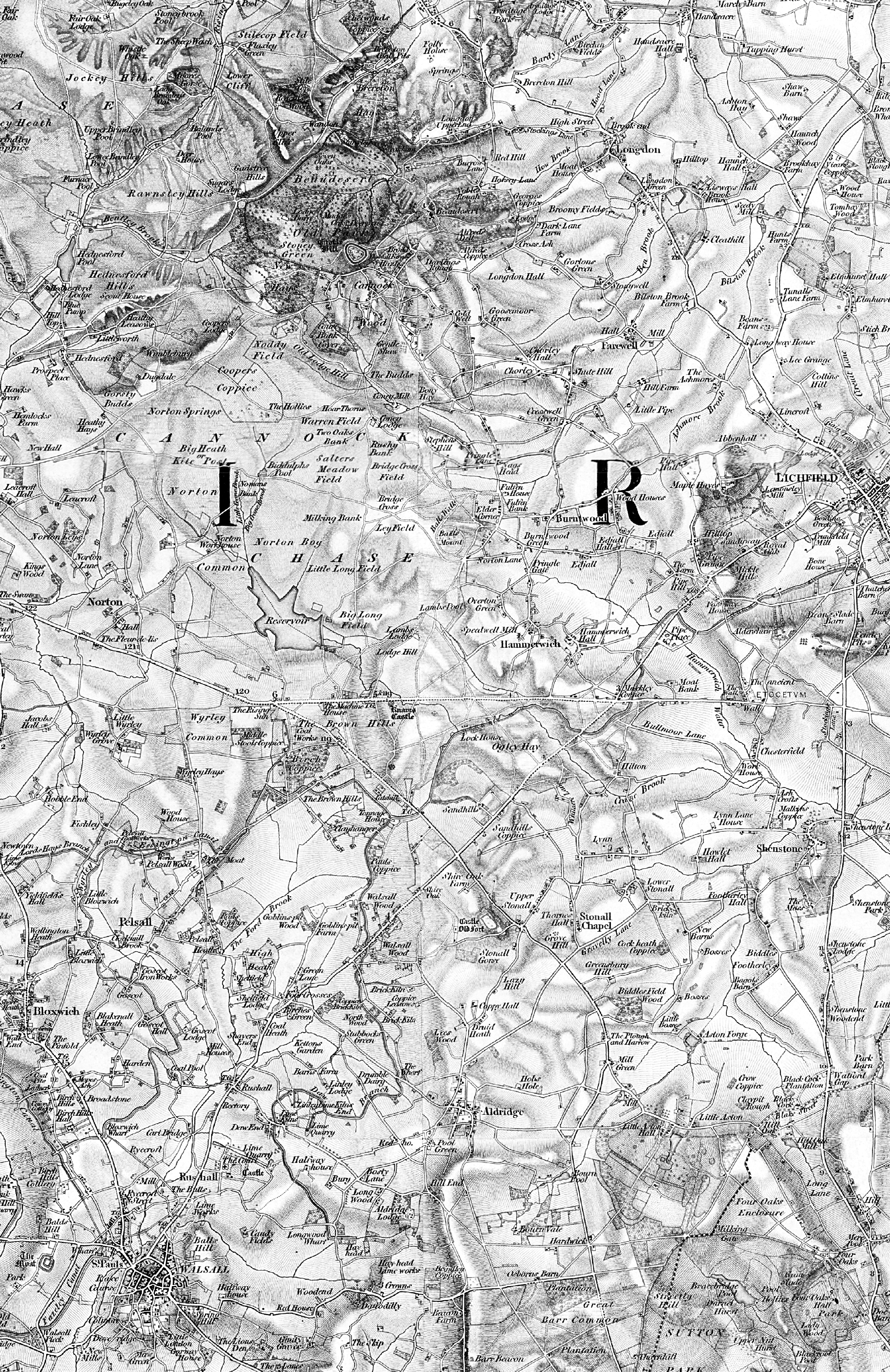
This is about 1:50,000, and is the first Ornance Survey mapping of our area produced. As Gerald Reece points out, it predates the 1938 Inclosure of Brownhills. Click for a much larger version – it’s a very big image, so please be patient.

These green and pleasant lands: carved into smaller and smaller chunks by sharp-dealing and self made men.
Welcome to the third of what was to be a three-instalment series, covering Ogley Hay, the history of Brownhills businessman Charles F. Cotterill and the towns evolution into the place we know today, as written by local historian Gerald Reece, in his remarkable book ‘Brownhills A Walk Into History’.
I’ve decided to split the last article in two as it’s a tad longer than I estimated. The final instalment will appear next week.
In the previous two articles in this series, Gerald has covered the original wastes of Ogley Hay, the Manor of Ogley Hay, the land Inclosure, and the start of industrialisation – Ogley Hay Steam Flour Mill. This section covers the increasing urbanisation of the land, and it’s carving into smaller and smaller chunks.
Remember that this whole thing came to our attention when Peter ‘Pedro’ Cutler found the bankruptcy sale notice in the Birmingham Gazette from 1850 – so it seems Cotterill, rather than sloping away, was experiencing some financial embarrassment. I’m sure there’s a tale there.
I will reiterate that these pieces are 100% the writings of Gerald Reece and I salute his brilliant, informative and influential work. Please, if you see a copy of ‘Brownhills A Walk Into History’ – buy it sharpish. I paid a several multiples of the cover price but it’s well worth the money. It remains the best work on Brownhills ever written.
XV OGLEY HAY FARM LANDS
Shortly after his victory Charles Forster Cotterill set about planning a ‘new town’ that he intended to develop on the site of his acquisition.
The main road through his ‘new town’ would run eastward from the junction of the Old Chester Turnpike Road (High Street) and Wolverhampton Lane (Lichfield Road). The new road would be named after him. Cotterill Road? Forster Avenue? Charles Street? Great Charles Street.
It was called Great because of its width, similar to the Great North Road and other Greats. Wide enough to allow a squadron of cavalrymen to ride in formation abreast. Even today the width is visible along the Council House section of the Street. It then narrows.
For once Charles did not get his own way; he was unable to purchase the small piece of land that would connect Great Charles Street with the Old Chester Turnpike Road. The area known as Brewe’s Comer is just over the Boundary and is in the Manor of Little Wyrley. It was not for sale. Great Charles Street took a sharp right turn and terminated in Wolverhampton Lane (Lichfield Road) instead.
Undaunted by his setback over the course of Great Charles Street, Cotterill set about utilising his ‘New’ lands. The area that he owned measured 160 acres, more or less. It was known as Ogley Hay Farm Lands.

Great Charles Street – named after Cotterill. From ‘Brownhills a Walk into history’ by Gerald Reece.
On 1st May 1839 Robert Brewer, a builder from Walsall, bought a parcel of land from Charles Forster Cotterill. It was:
‘An area measuring 2,483 sq. Yards, bounded by the Burntwood Road (Ogley Road) on the west having a frontage of 122 ft. On the south by Mill Street (Mill Road) having a frontage of 181 ft. On the east by First Street having a frontage of 125 ft. On the north by an intended road having a frontage of 125 ft. The piece of land being unoccupied and is intended to be built upon by the said Robert Brewer’.
Seven months later, in December 1839, Robert Brewer had a cash-flow problem and he was unable to make the payment for the land. After bargaining for the cost of the buildings that he had erected upon the site the ownership was returned to Charles Forster Cotterill on the 14th December 1839. The buildings that had been erected comprised of ten dwelling houses facing onto First Street. Complete with brewhouses and outbuildings and in the occupation of:
Thomas Evans John Lander
Henry Tisdale Francis Harvey
Thomas Edward Frederick Howell
Charles Camberlidge Edwin Pool
Thomas Davies Thomas Freeman

Census records. Remarkable research, from ‘Brownhills a walk into history’ by Gerald Reece.
Two dwelling houses and a stable fronting Mill Street and Burntwood Road, also 3 stables and 2 messuages occupied by Cornelius Bonell and Charles Evans, also one occupied by … Young. The remainder unoccupied. But perhaps the most remarkable development were the structures that had been built upon the area of land where the present Wheatsheaf public house stands. Here had been built ‘Four covered work-shops’ used as a Foundry and Steam Engine Manufactory and in the occupation of CORNELIUS BONELL & COMPANY. Industry, it seems, had at last arrived in Newtown, Ogley Hay.
The ‘discovery’ of the existence of the Iron Foundry and Steam Engine Works at Ogley Hay has been the most exciting find in my research into the history of Brownhills. I was very sceptical at first but as I found more documents to substantiate my finding I was really knocked for six. Details of the Iron Foundry and Steam Engine Works are very limited because of its very short existence. Thanks to the census returns, taken on the night of 6th/7th of June 1841, it is able to identify some of the employees, their occupations and their family details. Transcribed entries from the census are shown opposite. The census of 1841 also shows just how quickly Ogley Hay was developing. From being a scattered community of less than 20 in 1836 to one of 210 in 1841. Dwelling houses increased during the same period, from 6 to 47 with a further 8 in the process of being built or unoccupied.
On the 4th of August 1840 Charles Forster Cotterill sold off an area of land, measuring 2 acres, to Edmund Arblaster. There was built The Shoulder of Mutton in Church Road.
In September 1840 Robert Brewer, the builder responsible for the Iron Foundry and Steam Engine Works, ventured back into business. This time he purchased a square piece of land measuring 49 yds x 49 yds. situated at the comer of Great Charles Street and Burntwood Road. Price £18. Upon this piece of land was built Ogley Hay Farm House and Buildings. Ogley Hay Farm Lands had been subdivided into fields of various sizes and rented out. Many coal miners from the neighbouring coalfields increased their incomes by becoming part-time farmers.
In April 1841 Robert Brewer leased out part of the farm buildings to Samuel Smith of Walsall, gentleman. The remaining farm buildings were rented out on 5th July of the same year to Thomas Farmer Wood of Walsall, esquire.
The history of the demise of Ogley Hay farm lands is well chronicled from the 1840’s until the 1950’s. As it was sold off the ever decreasing area of land was documented on ‘Indentures’ recording the sale of leasings. ‘Indentures’ are records of transactions written on a sheet of paper, cloth or animal skin. Details are written twice, one inverted, then the material is halved using a scalloped edge cutting. This way the ‘Indenture’ edge can always be matched for authenticity.
Many of these indentures are now held in Local History Centres and County Record Offices. Old indentures are still thought to be worthless by many practices of Solicitors and they are still being ‘skipped’ at an alarming rate. Some even appear at car boot sales and ‘Antique Fairs’ where they can still be bought for less than a fiver. I have in my possession several indentures hand written upon parchment and dating back to the 17th century. When I handle and read a document of that age and I see before me history exposed yet not documented I realise my purpose and determination in writing this history of Brownhills.
The map that I have included shows the fields of Ogley Hay Farm Lands, circa 1860. The original of this map is in my collection.
Gerald’s own map of the Ogley Hay Farm Lands. From ‘Brownhills a walk into history’.
On 14th June 1842 Thomas Gittins, Clerk, of Wolverhampton bought an area of land measuring 1 acre for £30. It was situated on the comer of Lichfield Road (then the Wolverhampton Road) and the lane leading to Great Charles Street (No. 28 on the map). Three years later Charles Forster Cotterill bought back the land and the dwelling houses that had been erected there, Seven House Row, for £400.
On 22nd May 1846 Charles Forster Cotterill (the last Lord of the Manor of Ogley Hay) sold off his remaining holdings in the area and retired to live a gay bachelor life in London. From an ‘Indenture’ covering the sale we can see the progressive demise of the Ogley Hay Farm Lands already down to 135 acres. Not included in this sale were Seven House Row and the Farm Building on the site of the Warreners Arms. These had been mortgaged to secure a loan from the Birmingham Town and District Banking Company.
Included in the sale was the Iron Foundry and Steam Engine Works, sadly they are stated as being closed. In this section of the ‘Indenture’ Charles Forster Cotterill is referred to as ‘The Ironmaster’. The inventory of the manufatory includes: Cupolas, Workshops, Steam Engine face plate lathe with slide rest and headstock and all other machinery, gearing implements and apparatus affixed. It is still a thrill to realise the existence of this industry in the area.
The estate was purchased by the firm of Joseph Greene & Company of Liverpool. The business was directed by Mary Greene, widow of the founder of the Company, Joseph, and John Nicholson, Businessman. Nothing appears to have gone on between them, Jane Austen wise that is, they even split up after chapter three. Why did they choose to invest their monies in Ogley Hay? Railways? Perhaps.
Two Railway Companies had forwarded plans to Parliament at that time hoping to secure an Act and built a line through the area. In August 1846 they were each granted Royal Assent, then they agreed to amalgamate and form the South Staffordshire Railway Company. Joseph Greene & Company of Liverpool made a very quick return on their investment by selling part of their newly acquired estate to the Railway Company. Why though, has the seemingly astute Charles Forster Cotterill not taken the advantage?

Things are changing for some of us… but don’t panic! Image from Clean & Green Walsall.
I’ve long held that if you want to start a revolution in the UK, just disrupt refuse collections, so this is a headsup for everyone in the local area. This week, some refuse bin collection days change hereabouts. A full calendar leaflet can be downloaded from Walsall Council’s website here, but here’s how it works for local readers.
I know just how animated folk get about this, so here’s the relevant information.
Bear in mind that in all cases, the bins must be out by 7am now, as collections are starting early so they can be suspended during rush hour.
Area 1: If you normally have your bins collected Monday (Brownhills, Shire Oak, Clayhanger, parts of Pelsall)…
Area 3: If you normally have your bins collected Tuesday (Walsall Wood, Leighswood, Aldridge Central, Streetly), your collection day stays the same. You get a green bin collection every week until the 7th January 2014, when it returns to bi-weekly.
Area 2: If you normally have your bins collected Monday (Shelfield, Rushall, West Aldridge)…
In all areas, brown garden waste collections are currently suspended for winter, and will restart in April.
For other areas, please check the leaflet linked above.
I offer this for public information, as I understand it causes some confusion. I am human, and apologies if this is in any way inaccurate. It was right when I wrote it…
The change is apparently being made improve efficiency, and isn’t a hardship. No fatalities have ever occurred as a result of a bin not being emptied for a week or two.
Please note – I’ve done my best here, but please check if you’re unsure. Clean and green’s contact page is here, there’s a bin day calculator for your postcode here, and you can call Clean & Green on Walsall 01922 653344 if you need to, email them on cleanandgreen@walsall.gov.uk or visit their Facebook page or twatter account.

This isn’t Walsall – this is Little Aston, millionaires square mile, on rubbish day. Makes you glad to live in Walsall, eh?
Thanks to readers John Preece and Wendy McGreevy, I can share the following event with readers. It’s an interesting one, and looks fun. Could be just the thing to perk the kids up on a dull Sunday Afternoon – why pop along?
If you’ve any events you’d like me to give a plug to, just drop me an email at BrownhillsBob at Googlemail dot com. Cheers. Here to help.

Looks like a cracking event…
Norton Canes Christmas Fayre and Lantern Parade
At Norton Canes Community Centre
Brownhills Road, Norton Canes.
Sunday, 8th December 2013
3-6 pm
Free Face Painting and balloon modelling
Micky and Minnie will be coming along too
We also have fair rides, Candy floss
stall and much, much more.
Lantern Parade leaves Community Centre at 5pm
Santa and Cannock Chase Drum Corps will lead the parade.
Please join us for the afternoon
Oak Park – scene of both magic and loss. Better luck next year, lads!
It was a remarkable second chance at the FA Vase after the shock disqualification of Spalding United FC, but sadly, not to be. Walsall Wood narrowly lost their match today to Wisbech by one goal to none, thus abruptly terminating any hope of the boys from The Wood re-entering the competition.
Better luck in the Vase next year, chaps.
Bill Shaw submitted the following match report via David Evans:
Hi Bob
F.A. Vase 3rd Round
Walsall Wood 0 v 1 Wisbech Town.
A keenly contested affair, but Wood exited the competition for the second time this season falling this time to an 89th minute goal from Man of the Match Tom James.
The Fenmen had given Walsall Wood no time or space, and scoring opportunities were few and far between. James had hit the foot of the post on 67 minutes and he had always looked the player most likely to brreak the deadlock.
On 89 minutes Lunn had collected the ball in midfield & ran at the Wood defence, before playing a lovely diagonal ball into the right of the Wood box, Reed was in an offside position but made no attempt to play the ball leaving the way open for James to race past him, collect the ball & calmly score into the far corner past the advancing Rajaan Gill in the Wood goal.
So it’s Wisbech Town that go into Monday’s draw, whilst Wood look forward to a League visit next Saturday, 14th December up the road at Heath Hayes.
Bill Shaw.
Commiserations to the team, and as ever, thanks to Bill and David for the report – always appreciated.
For The Good of the Wood!

Brookland Road, from the 1920’s. Love the cart and the ghostly figure on the left. The cinema was nicknamed The Blood Tub for some reason. From ‘Brownhills and Walsall Wood on old picture postcards’ by Jan Farrow.
I thought I’d continue today with the third article in the series I started a couple of weeks ago, chronicling the memories of Walsall Wood lady Audrey Proffitt, carefully and faithfully transcribed by reader and Walsall Wood correspondent David Evans. The pieces form a magical sequence of vignettes illuminating life in the working class mining community that was Walsall Wood in the 1930s and 40s.
I’d like to thank Audrey and her niece, Sheila for their openness and hard work, and of course, as ever, David Evans, without whom this blog would be a far more tedious place.
Audrey and Sheila also helped create the fine article on the Walsall Wood Cossacks, the equine daredevils of the village which forms an interesting companion to this series.
I’t my privilege and honour to be able to share this material with readers. Today, Audrey remembers her neighbours and other characters of Streets Corner, the place she grew up.
Memorable events
When I was very young I can remember Uncle Jack holding me in his arms amongst a lot more people. We were on Streets Corner and people were shouting ‘Here it is!’ and uncle jack was telling me to look up in the sky and I saw what I thought was a big balloon. It was shining very bright with the sun on it. It was the airship R101 going by. I have looked up the date when this happened. It was October 1929 as I was three the following January.
I remember one of our neighbours coming to our house to ask Mom if I could go round to their house and play with Betty, her daughter while they listened to the wireless to hear the big ship, the Queen Mary, being launched. Mom said yes and when it time to turn the wireless on Mrs. Lenard picked Betty and myself up, sat us in the middle of the old scrub top table, gave us a paper bag and said,
‘Now you two sit quietly and eat these while we listen to the wireless’.
I shall never forget opening that bag and finding two big cream puff, choux pastry, dripping in chocolate. I had never had a cake like it. We were used to home made treacle tart and such. When people ask what stands out in your mind as regards nice things I always remember that cream puff.
I can also remember standing by the gate waving a little flag. It was the Duke of Kent coming by in a big car and he smiled and waved back.
I can also remember the elephants walking by up to Shire Oak Hill. I believe they used to bring them into Walsall and walk them into Lichfield. Mom told my brother Dickie to hold my sister Cynthia’s hand and they could go as far as Shire Oak Hill then come back if they wanted to follow the elephants. But they must have got carried away with the excitement of seeing these elephants and they followed them all the way to Lichfield, 6 miles away. I believe Mom was searching everywhere for them, when PC ‘Spot’ Warrington, the local Bobby, came to tell her they had received a telephone call to say they were on the steps outside Lichfield Cathedral and that some lady had given them a packet of crisps. He went to Lichfield on his push bike and brought them back, Cynthia on the crossbar and Dickie on the saddle rack. I don’t actually remember the incident but heard the story several times.
We had carnivals and circuses regularly when we were young and we had a picture house opposite the cemetery gates, ‘The Palace’ nicknamed ‘The Blood Tub’. We went regularly on Saturday. Dickie held Cynthia’s hand and sat me on his shoulders, then put a penny down and said ‘one please’, that meant one seat. Mr.Simpson who owned the Palace used to look at us over this glasses and mumble, ‘Oh, go on, then’.

The Blood Tub inside and out, in the 1950s. Image from ‘Memories of Old Walsall Wood’ by Bill Mayo and John Sale.
I don’t recall us being bored at all. We always had something to do. The girls would play ball up the walls or skipping. We had mom’s washing line in the days she didn’t need it. The line would stretch all across the road, one girl on each side of the footpath and about six or eight girls would skip in the middle. There were names for different kinds of games. I remember ‘Eevy Weevey’ and ‘Ella Fisher’. The boys would be happy with a football which nine times out of ten would be a pig’s bladder blown up. Dickie always had ours when our pig was slaughtered. Another popular thing for boys was a stick and hoop which was an old bike wheel which they would start rolling and follow it tapping it with a stick to see how long they could keep it rolling.
We could play safely in the road in those days as there was very little traffic. Occasionally we would have to lay the washing line on the road for a car but mostly for Mr. Allen’s horse and cart delivering the allowance coal. We sat hours on the kerb talking and playing marbles.
 #365daysofbiking Journal


 | Kevin Wilford on Mount Zion Sunday School Anniv… |
 | chrisjimallen on Down the tubes |
 | bravelyd03ee3c14f on Celebrating a Jubilee? |
 | Nathan on Raising damp |
 Posted with Blogsy
 RSS - Posts