I had another great piece incoming from David Evans while I was ill. David has been incredibly busy lately, sleuthing around The Wood to bring readers of the blog a whole tranche of articles, scans and memories from locals who remember the olden days. Amongst the treasure trove of artefacts David has located are a fascinating collection of material from the family of locals Pat and Bryan Lynk. These items include some remarkably moving items which I’m still trying to work out how best to present.
I’d like to thank Pat and Bryan for their generosity of spirt, memory and time in helping David and myself compile a bit more of the history of our area. The willingness with which you share your experiences and keepsakes today will hopefully help the generations of tomorrow understand what life was like in harder times. And of course, thanks are due as ever, to David who is generating copy at a frankly rather frightening speed.
It’s all welcome. Thanks to you all on behalf of both myself and the readers. Now, on with the story…
Hi Bob
You kindly put on your blog the job specs for two local houses in your article Quantity Surveying 1892 style recently. The builder was one Enoch Pagett. Following another cup of tea with this gentleman’s granddaughter I am delighted to pass on her further fascinating documents relating to the houses and to the people involved. Firstly, Enoch Pagett himself.
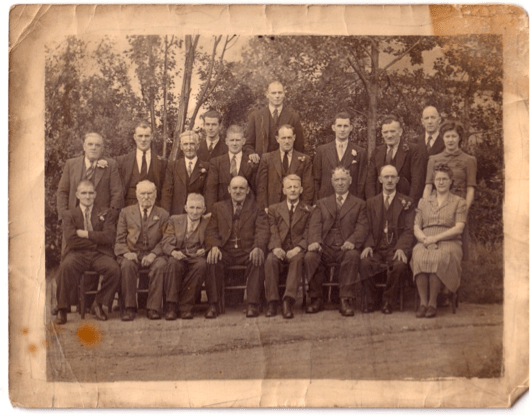
Image from the Lynk family archive, scanned by David Evans.
The above photo was taken in around 1948 and shows him seated on the first row, third gentleman from the left. In fact the photo is of the Friezland lane Working Men’s Club Committee, and you can see the clubhouse in the background.
Enoch was married to Elizabeth in 1896 at St John’s Church, Walsall Wood.
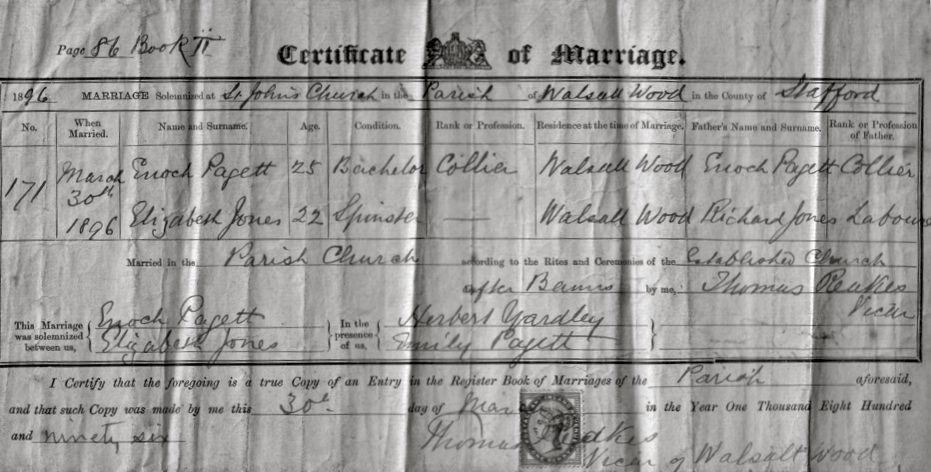
The 1896 Marriag Certificate of Enoch Pagett and Elizabeth Jones. From the Lynk family archive.
Enoch built the houses in Lindon Road. One of them was to become the home of his sister Sophia and her husband Harry.

The marriage certificate of Harry and Sophia Pagett, Enoch’s sister. I can’t quite make out Harry’s surname. Bardy, perhaps? From the Lynk family archive, scanned by David Evans.
Up until marriage, both lived in Paul’s Coppice. Whether this was an address on Lindon Road, or whether New Road had changed into Paul’s Coppice by then, I’m not sure. Paul’s Coppice as originally a wood behind The Wheel Inn. Note that Harry and Sophia also married at St. John’s, Walsall Wood.

Sketch of how the house Enoch built was laid out, supplied by the Lynk family and scanned by David Evans.
This shows the outhouses behind the main building quite clearly, as well as the main rooms. Interestingly the only water supply to the house was a cold water tap in the kitchen-brewhouse, although the house did have a flush toilet with its high mounted header tank, and access to this privy was from outside the house. Access to the small back bedroom was through one of the bedrooms. The floor in the front room, the parlor, was wooden and the back room had quarry tiles on bare earth. The coalhouse was also an important feature of this house. Coal was dropped in the street and had to be wheel barrowed into to coalhouse where it was sorted into slack, nuts, and raikers. The fire in the kitchen range was never allowed to go out.
The brewhouse had its boiler (called a kettle in the specification sheet), which was like a kettle drum in size, built into a brick surround in the corner and had a small coal fire underneath, and its own chimney. This was heated up on Mondays. Mondays were washdays, when hot water was ladelled into the washtub, clothes scrubbed, hung outside to dry, then put on to the rails above the kitchen range to air. On Fridays the boiler was used again for cleaning… And bath night! The tin bath hung on the outside wall by the brewhouse.
From the back bedroom the nearby canal bank was clearly visible, and the passing horses pulling the butty barges was a regular and pleasant sight as they carried their loads of coal or bricks along the cut.
The kitchen range was a feature in every house, and this was so until the 1930s. The range was cast iron, black, had a central small fire and a little oven on either side of the fire. Above this range was a rail with cuphooks on which could be hung the dutch oven or the frying pan.The frying pan, like the fish pan, was circular and had a loop handle over the top. Cuphooks were linked to adjust the pans over the fire. The round hand bowl with its handle was used to scoop the hot water from the boiler into the washtub where the washing would be dollied by hand, then mangled to remove the dirty water. Doing the family washing was a gruelling task!
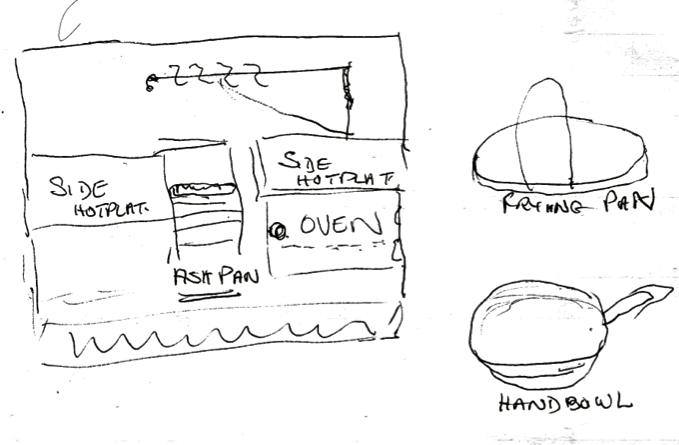
A sketch of how the range looked. Supplied by the Lynk family, and scanned by David Evans.
Enoch, the builder, his sister Sophia and her husband Harry died many years ago. The houses were pulled down quite a few years ago. Their Working Men’s Club in Friezland Lane is no longer there but I hope that many readers will recognise Committee Members from this more recent photo:

Friezeland Lane Working Men’s Club committee phot from, I’m guessing, 1964. I’m keen to identify the gentlemen in the picture, as the history of this club, and others in the area, isn’t something we’ve covered enough on the Brownhills Blog. Picture kindly supplied from the Lynk family archive and scanned by David Evans.
I am deeply indebted to Mrs Pat Lynk for her generosity and kindness in offering these photos, documents and her sketch plans and her detailed personal memories and description of the building, and the people, from this part of Walsall Wood’s history for all your readers to enjoy.
David Evans January 2012
















 RSS - Posts