

If this blog is about anything at all, it’s about just how relevant our local history is to what we do, are and feel today. I passionately believe that exploring our collective past can teach us things about the present that help us make sense of, interpret and explain what we see around us.
I’ve been hugely engaged by the level of comment and involvement with the recent discussions about the history of coal mining on Brownhills Common. Through maps, recollections, books and existing evidence we’ve begun to find out more about this vital component of the past Brownhills. This industry shaped the town character, it’s environment and landscape. With that in mind, I think it’s time we united that knowledge with some new technology.
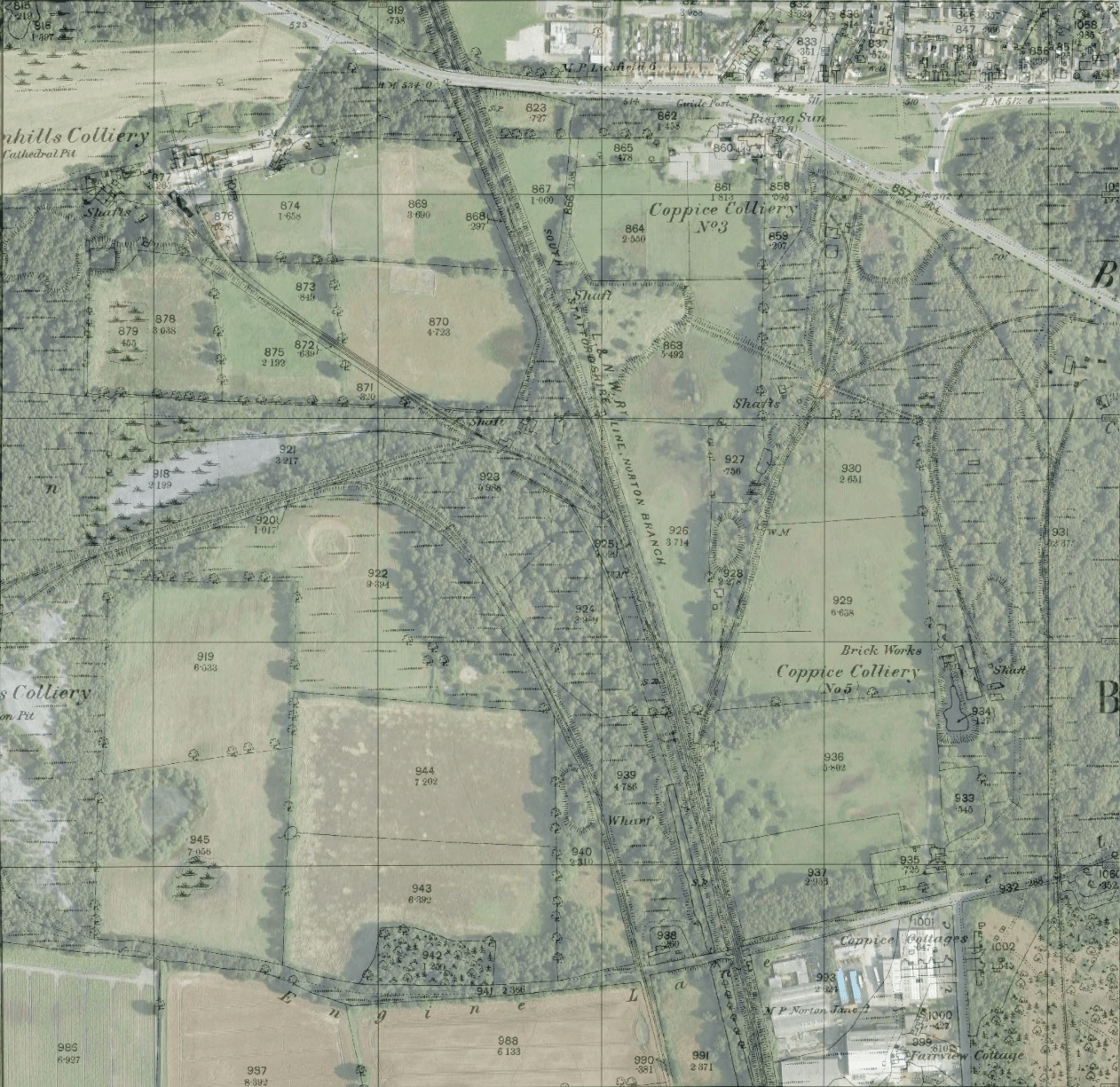
1884 1:2,500 map overlay semi-transparent in Google Earth. Click to enlarge.
Long-time readers will know that I’ve made Google Earth overlays out of old maps for some time. These enable you to load a map over satellite imagery in Google Earth and fade the map in and out to see fairly accurately where old features were. I’ve now done this with a selection of the 1:2,500 scale Ordnamce Survey plots of the common area I posted last week. These are fun to play with, and help show how and why the landscape of the common is such as it is.
Further, though, I’ve enabled these overlays to be loaded into compatible Garmin GPS devices. If you have a Garmin Oregon, Dakota, Colorado, GPSmap 62 or Edge device or similar modern, colour mapping Garmin device, download these overlays from the links at the bottom of the post, connect your GPS and copy them into the \Garmin\custommaps folder and enable them one at a time from the ‘map setup’ menu on the device after rebooting. That area of the common will now be represented by the old map overlay you selected. They can be flipped, or turned off, at will. They work best at scales olf less than 200 feet.
This, I hope, will enable the fairly precise location of long gone surface features. I will certainly be exploring using the maps. Please be aware that inaccuracy in scans, surveying and the GPS system mean that this isn’t a precision guide – and I bear no responsibility if you fall down an old mineshaft, though I’d love to know the location of it if you do. They’re good enough to help locate stuff that may formerly have been hidden, and I’d certainly expect accuracy to within a few metres.

Here the 1884 overlay is seen in use on a Garmin GPSmap 62s.
If you want a guide to using the overlays in Google Earth, see my past post ‘Mapping the past’ in which the process of loading them and manipulating them is explained in full. The relavant files for this batch are hosted at my Box.Net account and can be downloaded by clicking the following links.
If you use them, please do let me know how you get on, and I am, of course, still open to contributions on the topic as a whole. Happy exploring…