

It’s always nice to kick off a new historical thread here on the blog, and this one will be particularly wonderful to curate, as I know there’s a lot of local interest in the old cricketing history of Walsall Wood.
The young David Evans, ever keen to get out and engage with the history of the village has been dashing here there and everywhere over the past few weeks, checking out leads and recording material for a remarkable series of articles about Walsall Wood’s cricket and other sporting exploits.
The Wood has once again resonated to the sound of willow upon leather as David scratched his head feverishly over yet another fascinating historical puzzle, and with the new season underway, what better time to investigate it?
Without further ado I’ll let David explain in a great introduction. I thank him for his hard work and selfless dedication, as ever, to recounting communal oral history before it’s lost.
Please feel free to join in with comments and recollections.
This is very important work, and I’m so glad David is sharing it with us.
Making the pitch – the beginnings of Walsall Wood Cricket Club
Walsall Wood would have been ‘a very naked place without the cricket club’, according to Councillor J D Holland in 1947 – today, there is little to see that gives much of a clue as to the long and noble tradition of this great game in Walsall Wood.
Today, only the name Boundary Close gives any clue as to where the village cricket pitch existed.

Cracking photo – that chap in the cap, front row left looks like a bit of a lad. Image from ‘Memories of Old Walsall Wood’ by Bill Mayo and John Sale.
This image appears in Bill Mayo’s book, Memories of Old Walsall Wood and is kindly offered by him to form the starting point of an investigation in to the history of Walsall Wood’s cricketing history.
I remember the glorious sounds and sights of the team playing on their pitch which, in the 1950s, was at the back of St. Johns church in the High Street, Walsall Wood. In a previous post entitled ‘Fielding suggestions’ and the followup article ‘When an old cricketer leaves the crease’ which both discussed the cricket team, this amazing pair of press reports from the Lichfield Mercury were discovered by Peter ‘Pedro’ Cutler:

Lichfield Mercury, Friday 13th August 1933. Click for a larger version.
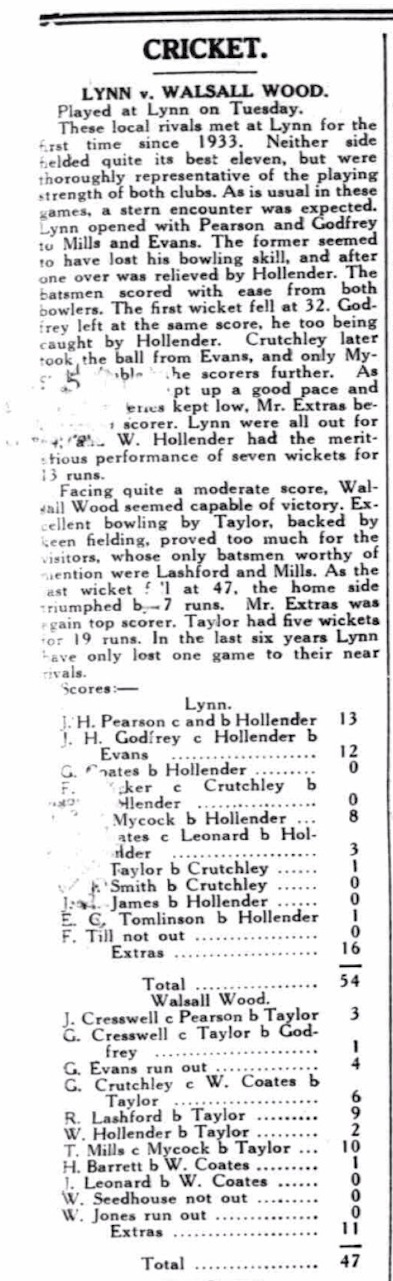
Lichfield Mercury, Friday 12th July 1935. Click for a larger version.
Seemingly the Walsall Wood Wesleyans cricket club changed its name when the Wesleyan and Primitive parts of Methodism became unified. But when was the cricket club founded? We know that the first Wesley Church in Walsall Wood had stood along the Turnpike Road, south of the canal, and had been built in 1878.
I have located a copy of a poem which I’ll feature in a later article, that records the Wesley Cricket Club in 1906 and I have been told that the club had originally played in a field behind the Horse and Jockey Pub, in the Jockey Meadows.
This helped to clear up an intriguing question that had troubled me for some while, as the 1926 Aerofilms photo of the village appears to show the presence of tennis courts and a bowling crown green, but a marked absence of a cricket pitch behind the church at that time.

Walsall Wood from the air, by Aerofilms in 1296. Note the fields behind St. Johns (obscured by trees) – they’re not cricket. Image supplied by David Evans.
Back in those days, the Horse and Jockey Inn had boasted a well known and respected landlord, known locally as Jockey Joe Blakemore who ran the hostelry with a somewhat legendary iron hand, from 1914 to 1954. Fortunately Joe’s son Dennis, who is now in his 90s, was born and grew up in that pub, and still lives in the village.
Over a few cups of tea and friendly chats Dennis kindly gave me some fascinating information about the original Inn that he remembered from his childhood, the stables, the bowling green just at the rear of the pub, and also the double gate to the Jockey Meadows which led down to the stream.

Joe Blakemore outside his pub, which was a house of some repute. The old building here was only demolished around 1992. Image from Memories of Old Walsall Wood by Bill Mayo and John Sale.
Dennis told me:
The first cricket pitch was in the lower field, and had a wooden pavilion with changing rooms for the home team and the visiting team. But the lower part of the pitch was prone to flooding and eventually the team moved to their new pitch behind the church.
There was also a red ash running track in the meadow, and the fairground was there too! The Walsall Wood Football team played on a pitch in one of the higher meadows.
Dennis recalled the double and single gate and the banner for Walsall Wood Football Club. It seems that the Jockey Meadows seem to have been an important part in the village life’s social events and sports in those days, that may have been forgotten in more recent years.

Jockey Meadows – now a Site of Special Scientific Interest – once apparently the scene of great sporting endeavour. Who knew? Imagery from Bing! Maps.
A chance encounter and friendly word with a kindly passing couple as I left the Dairy Farm in Hall lane having taken some photos has led me to being shown an absolute treasure trove of newspaper cuttings and photos of the Walsall Wood Cricket Club, and their Village Carnivals, which I am delighted to be able to share in subsequent articles.
I would like to thank Mrs Lynda Greatrex and Mrs Cynthia Gill for so readily offering these photos and newspaper cuttings of the Cricket Club that they knew in the childhood, when their father, George Crutchley was the captain, to researcher extraordinaire Peter Cutler, to Bill Mayo for kindly allowing me to include images from his book, and to Mr Dennis Blakemore.
David Evans
April 2014