

One of the wonderful things Gerald Reece sent me following our recent email exchange is a scan of a compilation of tithe maps of western Brownhills. I wasn’t actually aware this existed, and it helps clear up a few things, whilst raising many other questions. It’s a scanned from a hand drawn copy, and is a beautiful and fascinating document.
The sources of this plan weren’t maps to enable people to find their way; they were legal documents for use by the church. I’ve featured an enclosure map map before, which is a similar idea. Up until 1838, Ogley Hay had been extra-parochial – it was outside any parish, and therefore not subject to the tithe, the Parish tax of a tenth of your income to the church. When the parish was declared in that year, a record was needed of who owned which parcels of land, and what they were called. These were drawn up on a tithe map – only loosely to scale, the data being far more important.

The site of Swingbridge Farm in 2007. Was that really five years ago? One of my first pictures on Panoramio.
This map in question is the combination of the 1840 Tithe Map of Brownhills and an 1828 one for Norton parish. It indicates parcels of land – mostly fields – and their names. There would have been a key as to who owned them. Like Brian Rollins’ coal maps of the common, it’s drawn in a n odd orientation, so I’ve included a second image of the same map rotated so that north is to the top.
One question this map does answer is the one about the house and engine sale found by Peter ‘Pedro’ Cutler a few months ago. You’ll remember that, at the time, I jumped to the wrong conclusion that the subject of the sale was on Engine Lane. Gerald Reece subsequently communicated that he thought the actual property in question might be Swingbridge Farm. This was an interesting proposition; Gerald asserted that the acreages fitted, and the house was of the correct size, yet I remained sceptical.
Swingbridge Farm was the farm (now demolished) that stood on the canal between Clayhanger and Brownhills. A pig farm for it’s final decades, it gave Brownhills a very distinctive smell for years. It never occurred to me that the farm was so old, or had such an interesting history.
If you look at the below fragment of map, this is Swingbridge Farm by the canal bend.

Fragment of Tithe Map covering what was Swingbridge Farm, the old pig farm on the canal between Clayhager and Brownhills. Note ‘Engine Piece’ on the other side of the canal, where the Watermead Estate stands now.
Note the Swan pub, left, and ‘Fore Draught’, a narrow track to swing bridge farm, which still exists through the Watermead and over Cooper’s Bridge today. In those days, access was very probably via a swing bridge, after which the farm was clearly named. If one is to look at the field over the other side of the canal and above, it’s called Engine Piece. This is remarkable.
The only reason that could have been called Engine Piece is that it contained an engine of some kind – and there’s more than one use of the nomenclature on this map. The suggestion is that it was a pump, and the shallow mines alluded to in Pedro’s auction were on the land nearby – what its now the Watermead, and previously the race course fields loaned by William Roberts.
That there may have been shallow mines there may surprise some, but think about it. Coal was opencast at Swan Works in the 70’s, so there’s shallow coal nearby. Both Birch Coppice, which once covered the land where Swan Works is, the common to the north and Swag towards the west and Pelsall were all heavily bellpitted. It’s sensible to think the same occurred on land between the Pelsall Road and the canal.
Below, I include both images of the complete tithe map so kindly supplied by Gerald. The first is as is, the second rotated so that north is up. I’ve placed links below each image for direct downloading.
Please take a good long look at the map, and see what you can find. It rewards close study.
Again, my profuse thanks to Gerald Reece for this wonderful insight into history.
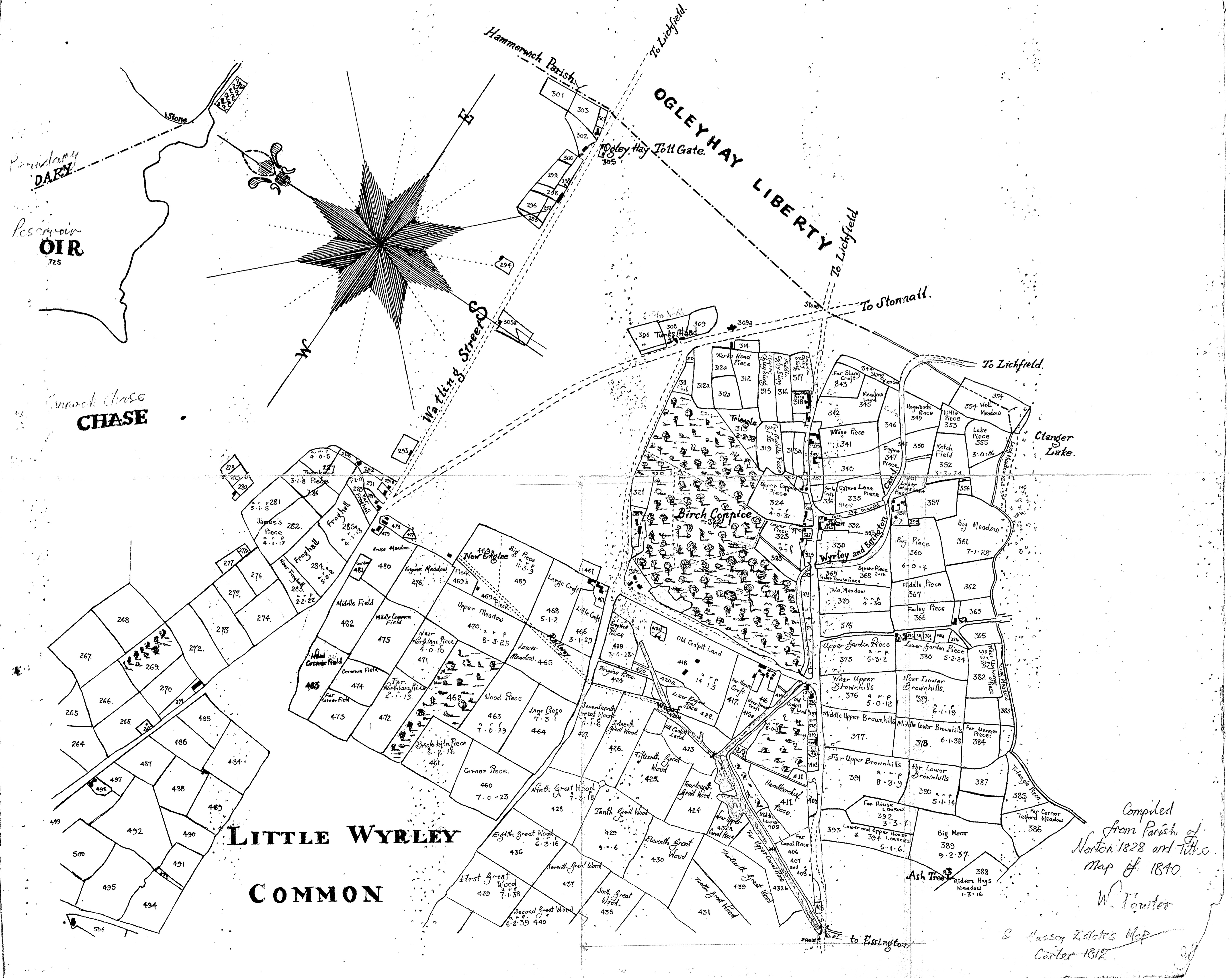
Compilation tithe map kindly supplied be Gerald Reece. Click for a larger version.
1840 compilation tithe map original orientation

Compilation tithe map kindly supplied be Gerald Reece. Click for a larger version.