

Thanks to reader David Oakley and the ever-diligent [Howmuch?], I’ve since found out that my speculation that Moss Pits was the location of Clayhanger Pumping Station to be utter twaddle. I’d heard the name before, yet couldn’t locate it. Since many of the reports mentioning the place were in connection with sewage, I assumed it had to be either Clayhanger or the nightsoil farm, latterly waterworks near Bullings Heath, Walsall Wood.
I couldn’t have been more wrong. It turns out Moss Pits is actually in High Heath, on the Pelsall/Shelfield border. The pumping station was adjacent the Ford Brook. This has caused me a great deal of thought. Were Brownhills Urban Dstrict Council responsible for this area? If not, why were they running a water pump there?
My feeling is that the Ford Brook was at that time in transition from being an open sewer, back to being a brook again as the sanitation systems improved. I have no proof of this, but it seems likely.
David Oakley was bang on with the location, as this rather grotty 1:10,000 scale map from 1921 shows.

Rather rough 1921 1:10,000 Ordnance Survey plot of Shelfield/High Heath. David Oakly is quite right, the mill was nearby. Note School Farm, to the right, a name still present today. Click for a larger version.
These days, the area is pretty much all housing, and the Ford Brook Valley is mostly greenspace. The site of the pump and sewage works seems to be what is now Lawley Close. I’m wondering what, exactly, this pump did, and why is was rendered obsolete. It seems likely that there was a chain of pumps down the Fordbrook/Goscote Valley and associated sewage plants – after all, it’s all downhill to the big installations at Goscote, and latterly Bescot.
My interest in these drains continues – they clearly made a huge difference to the quality of life for everyone, and were a triumph of civil engineering, if not without their failures. Yet, there seems to be little record of their creation, installation and operation. No, they’re not as handsome and awe-inspiring as bridges, churches or othe civic Victoriana, but they made for healthier citizens and must have been a huge amount of work.
What do we know, readers? Contributions, as ever, are invited.
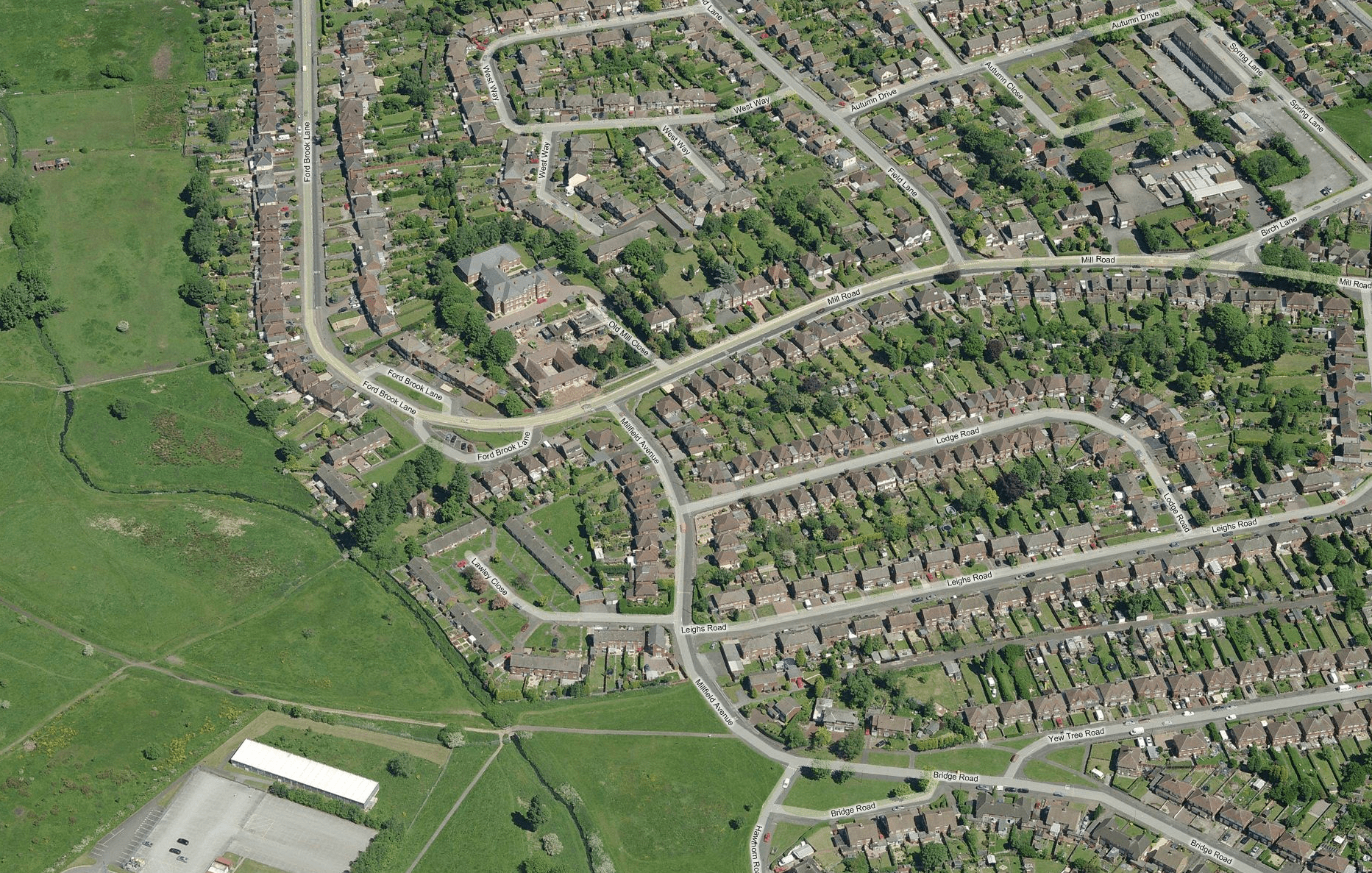
Current day imagery from Bing! Maps. Note Old Mill Close, and what appears to be the old farm house still extant. And the dirty old Ford Brook, still flowing along… click image for a larger version.