

I owe Peter Cutler an awful lot of beer. He spends hours and hours trawling the net, just looking for stuff that may be of use to the blog, and of interest to the readers. Without his work, and of course, that of other contributors, this blog would be a much poorer thing indeed.
Every so often, along with the very high quality stuff Peter finds, he strikes gold. And so it is with this piece. Found coincidentally to reader Alan Harvey’s request for more Norton Canes, this article on the village, from the Saturday, 30th January 1886 copy of The Graphic, is a remarkable travelogue written by a visitor to a small, dirt-poor community, just before everything changed.
There are telling phrases here ‘…as far distant as the millennium’, ‘Their whole life, from the cradle to the grave, is one series of trouble and toil…’. I had no idea – although it’s logical now it’s been mentioned – that pit-ponies caused so many injuries. The death from lock-jaw (tetanus) is a grim and a sobering reminder of life without modern medicine or the NHS. The optimism about public education is refreshing.
This was our local community, 127 years ago. How far we have come. Never forget that.
Please, do comment and contribute. More Norton to come later in the week. BrownhillsBob at Googlemail dot com. Cheers.
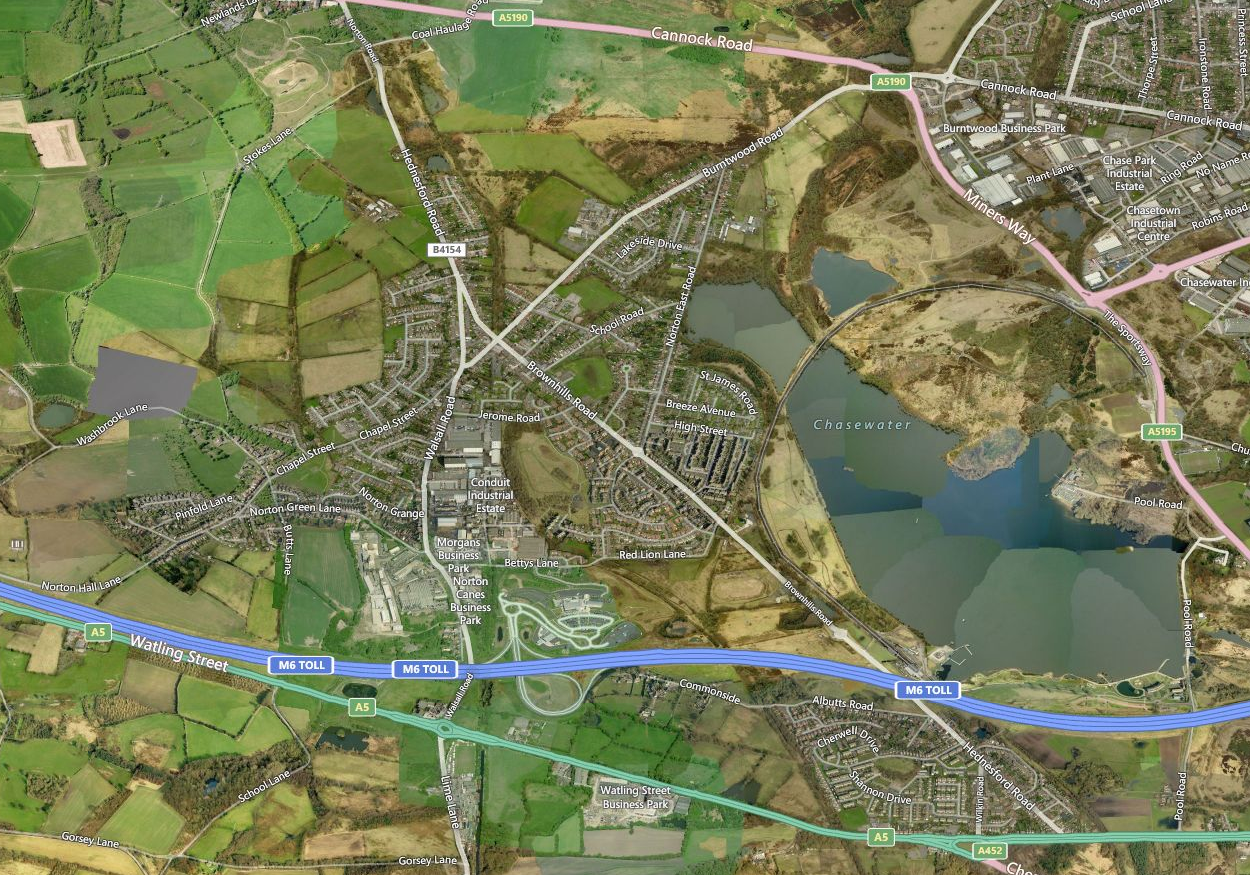
Norton Canes today is a modern, busy community. Imagery from Bing! Maps.
IN A STAFFORDSHIRE VILLAGE
Last summer I entered a Staffordshire hamlet for the first time. The village I marked out for my visit was a quaint, straggling, little place on the borders of Cannock Chase—the latter a beautiful picture of wild scenery, with banks covered with the longest ferns I have ever seen—and known as Norton Canes. I was unable to note much on my entry, as it was quite dark when I reached the Valley of the Trent, and from Lichfield—immortalised as the birthplace of Dr. Samuel Johnson, and where his statue still figures in the market- place—I had a good seven-mile drive across country. In the morning my first acquaintance with Norton Canes was made, and the first thing I saw was the whole machinery and surroundings of a coal-pit in working order. It was not a hundred yards away from the window at which I stood, and I could stand and watch the frequent revolutions of the chain wheel over the shaft, as the truck-loads of coal were drawn to the surface, or miners descended into the very bowels of the earth. I almost shuddered as I imagined the dangers that awaited these brave men underground.
The village itself cannot he compared with any of the rural retreats that dot the southern counties of England; it is only a crooked little hamlet in unison with its smoky surroundings. It is a village of one street—like the majority of northern hamlets— although from off the parent thoroughfare three or four narrow winding streets branch. Every house is built of sombre red brick ; none of those pretty, slanting-roofed, thatched cottages that you see in Kent or Surrey, with the swallows and sparrows building beneath the eaves, but only dark, square red houses with very little garden eilher back or front to lend them some vestige of beauty. In the course of my peregrinations around the village I only came across two thatched houses, and these were excommunicated from the habitations of miners. For all these red houses are inhabited by the pitmen, many of the buildings being the property of the owners of the various collieries, while some are built and paid for by the colliers themselves out of their savings. The collier’s wife is extremely clean, and her family unusually large. I saw one woman who had had two-and-twenty children and seventeen were now living. Several women are in possession of from twelve to seventeen, and yet these prolific mothers are not verv advanced in years. They marry exceedingly young, men enter the matrimonial state before their twentieth year, and consequently from these early unions spring numerous children.

A postcard of the Conduit Pit. Like Brownhills, Norton was born out of, lived and died early through the black stuff. A great image from David Evans.
How they all live and thrive as they do is one of those mysteries not dreamt of in the philosophy of Horatio. Heaven knows the struggle is very hard for these women to keep body and soul together more especially in the summer, when there is little demand for coal and wages are bad; but they are never the ones to complain and they are endowed with the patience of Job. Their whole life, from the cradle to the grave, is one series of trouble and toil, and experience has taught them to be reconciled to it.
The background of Norton Canes is composed of pits with tall shafts and smoking chimneys, forming rather a rather gloomy picture to the landscape around. Many of the paths are strewn with ashes and the latter, when Boreas is at the height of his play, fly about in all directions, making it very uncomfortable for the pedestrian. There are no buildings of any importance, such as a concert hall or reading-room or library, where men, after their labour, may become intellectual; such benefits as these do not figure in the category of miners’ comforts. Even the church and school are beyond the reach of those who dwell in the most thickly-populated part of the district, being fully a mile and a half away, in the lower extremity of the village, thus preventing many from attending the worship of the Church of England, owing to their refusal to walk so far. However, to console them for the loss of one house of prayer, they have a Presbyterian Chapel in their midst, and a Salvation Army, the latter never failing to make itself heard on every night of the week.
Of course the principal institutions, and those on which the surrounding hamlets depend for their existence, are the collieries, and very valuable institutions, from a commercial point of view, they are. Nearly every man and boy in the village and for miles around pass their lives in these deep pits, and toil hard for the coal which makes the poorest home cheerful. We in London do not realise sufficiently the hardships and dangers undergone by these strong, hardy men in their labours beneath the earth’s surface, and how badly they are paid for rendering such a service to the community at large. Such poor remuneration is the cause of frequent strikes. Even while I was there many of the men were up in aims because of the scarcity of wages, and the owner threatened to close the pits unless the contumacious ones accepted his decision. They appeared determined to hold out, and maintained, if they could only get a general strike, that it would be a grand day for them. But I am afraid that grand day for the miners is as far distant as the millennium. Even this little episode illustrates clearly the dissatisfaction existing among the pitmen, and how hard it is for them to make both ends meet. Their rate of wages is one penny per hundredweight, and those who are conversant with the working of the pits can imagine how long it takes before the collier can dig out from the solid, and send up to the pit’s mouth, his ton of coal. There is not only the labour of getting the coal out of its bed but there is the building up again the great gap made with earth and trees, lest the roof should fall with a crash and bury men beneath it. The labour, therefore, is great both ways, and the reward undeniably small.


A fascinating 1884 plan of the coal workings of the Norton Conduit Colliery and their interaction with the railway above. To see the post this relates to, click on the image.
To those who have never seen a pit a short description may be interesting. On entering the yard you pass by the engine-house and other necessary paraphernalia for the working of the pits, and make straight for the shaft, where the cage is ready to conduct you into the bowels of the earth. Above is the great wheel round which the steel chains revolve and work the cage with almost lightning rapidity. Standing at the brink of the pit’s mouth you look down and there is nothing but total darkness. It is like peeping into the bottomless pit itself. The wooden cage comes up, and you take your stand upon it, and before you can say ‘Jack Robinson,’ the engine is set in motion, the wheel above you revolves and loosens the chain, the lever is pulled, and the cage drops, and in less time than one can write it, you are more than four hundred yards below the surface of the earth. The journey is sudden and decidedly unpleasant, you have a notion that all your breath is gone, and your stomach completely overturned, and when you again touch terra firma you are in a dazed, bewildered, and half-fainting condition. But a little brandy soon restores animation, and after you have collected your scattered thoughts, and regained some of your lost breath, yon laugh and wonder at the rapid journey you have made, and cast an eye upon your underground surroundings. And very dark and dismal ones indeed they are. In all directions run long, narrow roads, so low some of them, in parts, that you are perforced to bend your back if you would save your head. A stick and a safety lamp are given you, so, aided by these valuable articles, you commence your underground pilgrimage. Many of the roads are a mile and a half long, and, although a miner may live opposite the pit’s mouth above ground, yet he may have a mile or more to walk after he has descended into the earth. Like mariners on the sea these workers underground have their various charts, and can tell exactly where they are. They know almost every house they are under; every field, road, and river; and they can tell within a foot if they are approaching another man’s territory. What strikes the explorer more than anything is the number of horses employed in the mines, and their diminished size. In the pit under description there are, in constant work before our eyes, nearly a hundred horses, and it astonishes many how they travel so fast through these dimly-lighted subterranean passages. As each little truck is loaded with the coal, it is borne in the cage without loss of time to the surface. Many of these animals have never seen daylight, having been born and reared in the mine. Even those horses that have at some time or other been the inhabitants of green fields and meadows, have become so used to their perpetual darkness that, were they to be put back into their old delightful haunts, it would take them some four or five days ere they recovered the power of sight. The miners are in great danger through these animals, for the roads are so narrow and low, and the horses come along at such a terrific pace at times, that before the man can steer clear of their path he is knocked down, and perhaps receives some irreparable injury. Accidents are very frequent in the pits, and the roll-call for one year presents a number that is heartrending, and almost incredible. Speaking in the House of Commons in July, last year, Mr. Burt said that the number of people who had lost their lives during the year 1883 was 1,140, thus showing the dangerous and hazardous work these brave miners have taken upon themselves to perform. Even during my short stay in the village a young lad had his foot smashed beneath’a loaded truck, and, after lingering lor a few days in great pain, lockjaw intervened, which soon terminated in death. I saw him buried; a simple, touching burial that could not fail to move the stoutest heart, with the rude but sympathetic miners following sadly their young and unfortunate comrade to the grave.

An early postcard. The architecture is amazing – vey intricate brickwork.
Education is the miners’ chief drawback—it cannot be called a fault, for theirs is not the blame—and there are not two men out of a dozen who can write their own name, or read four words out of a child’s school-book. It is disheartening to think that such ignorance should exist among such a fine body of men. If a man is able to read aloud the daily paper he is considered a great scholard – always the d at the end – and reckoned some one of importance among the small fraternity. But the reason is not far to seek why such ignorance reigns in these days of Board School and cheap literature. When they were lads no such facilities were open to them; the Board School was a thing undreamt of, and cheap literature out of the question: so that learning was in every way beyond their grasp. Almost as soon as they could walk they made acquaintance with the interior of the pits, and at an age wne they should have been wading through their first primer, they were learning the rudiments of a collier’s life. But happily things are changed now; education has spread its light among the dark territories of coal; the Board School opens its doors to the miners’ children; and if the colliers themselves suffer through their ignorance, they have the consolation of knowing that it will not be so with the little ones growing up before them.
And I deem it no idle prophecy that, in the years to come, miners will be an intellectual body of men.
H. H. A.