

John Anslow – local historian and along with his late brother, one of the foremost chroniclers of the history of Walsall Wood – has been emailing again with another fascinating artefact from The Wood and he makes some fine observations upon it, and in particular on the General Strike and life in the 1920s.
John also has some questions to ask, and I hope readers can help with those, please – John has been responsible for some of the most important articles on the blog over the years, and I’d love to see what readers think about this one.
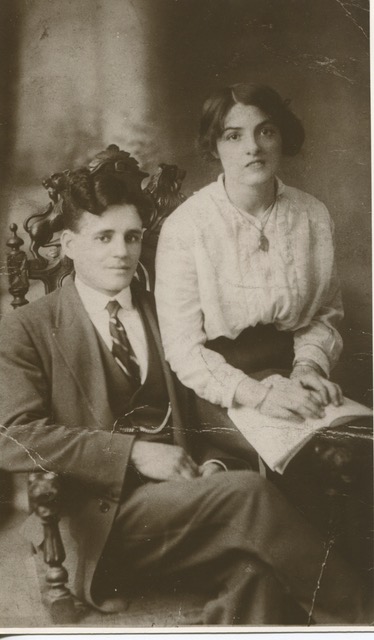
A miner, lost too soon, and his wife – Abe and Eliza Anslow, taken around 1918. Image kindly supplied by John Anslow.
Without further ado, John Anslow wrote:
This might interest you and your readers, Bob.
The photographs show what I believe to be my grandfather’s last wage packet, dated 8 June 1928; he died shortly afterwards, aged 38.
Abe Anslow was a coal miner (a hewer, on the death certificate) and that particular week in June, after mining one-and-a-half tons of slack and two tons of ironstone, he took home eighteen shillings and eight pence, or about 93 pence in today’s money.
According to the CPI inflation calculator, £1 in 1928 would have had the same purchasing power as £63.24 today.
This little scrap of paper set me thinking, and I should like to enlist the help of those who know much more about local mining history than I do.
First, the wage packet itself.


Images kindly supplied by John Anslow: Click for larger versions.
(i) The stall number, I believe, refers to an eight-yard section of the coalface allocated to a pair of hewers.
(ii) The seam is identified with the letters “D. T.” Any ideas?
(iii) What are the “percentages” referred to here? (H2 – 3s 4d and 1 @ 8s 9d)
(iv) I hadn’t realised that ironstone was mined in the coal pits hereabouts.
Next, the historical context.
From what Dad told me (8th June 1928 was his seventh birthday) the 1920s were desperately hard times for mining villages such as Walsall Wood, though he recalled many instances of people looking after their neighbours and struggling through together. I have mentioned in a previous comment on your blog the arrangement Abe had with Mr Headley, who supplied animal feed on credit and was repaid in bacon when a pig was slaughtered.
The General Strike of 1926 must have been particularly harrowing for mining families. As you doubtless know, it was called in response to the miners being locked out by the coal owners on 1st May 1926 after refusing to accept a cut in wages and longer hours – “Not a penny off the pay, not a second on the day”.
In coal fields throughout the land, miners were out of work for over six months but gradually began drifting back, on the owners’ terms, during October and November. I assume events in Walsall Wood mirrored those in the rest of the country.
It’s doubtful there’s a local resident alive today who remembers the lockout – anyone capable of doing so would now be in their late nineties – but perhaps readers can recall tales told to them by parents and grandparents.
Finally, a few comments about local industrial history.
I am dismayed that people barely twenty years my junior know nothing of the General Strike, let alone its causes or the hardships endured by the miners and their families. Nor are they aware of the poverty that was endemic in mining villages right up to the Second World War.
It is not my intention to embarrass you, Bob, but your blog plays an invaluable role in keeping the folk memory alive: helping us to remember who we are and where we have come from.
I was fortunate in being able to talk to people of my grandparents’ generation who, in turn, related stories their grandparents had told them. In two degrees of temporal separation I was back to the years when the canal first came through the village.
This experience makes me feel rather like the elderly lady who, when interviewed by a journalist in the 1850s remarked: “My first husband’s first wife knew Mr Cromwell and said he was a very nice man!”
All the best,
John Anslow
An afterthought
For completeness, and so that you can picture the man who spent his working life kneeling deep underground, hewing coal for such meagre recompense, I have attached a photograph of Abe and his wife, Eliza, taken around 1918.
- John
I welcome all view, clarification and memories on this, and I know John will too: Comment here, mail me on BrownhillsBob at Googlemail dot com or find me lallygagging on social media.
This is a fine contribution for which I am, as ever, indebted to John Anslow. The brothers Anslow have shone a beautifully crafted light upon some of the wonderful, little-known corners of Walsall Wood history – from sneaking into garden parties to cocksure monstinks; from dignity in poverty to odd interconnected stories, the Anslow boys have been behind some of my very favourite things to share here.
I am honoured to be able to feature these contributions here. Thank you John.